
Top 12 Teas Health Benefits in TCM (Nature, Flavour, Actions)
Many years ago, I lived and worked in Morocco, where the summer temperatures regularly climbed above 35°C (95°F). Despite the intense heat, one of my favourite daily rituals was drinking traditional Moroccan mint tea.
At first, it seemed completely backwards. Why would anyone drink a steaming hot beverage on such a hot day?
The answer perfectly illustrates one of the core principles of Traditional Chinese Medicine.
Although the tea itself was warm, mint has a cooling energetic property. Instead of making me hotter, it actually helped cool my body from the inside out.
That experience stayed with me because it demonstrates something many people don’t realize:
Every tea has its own energetic nature, flavour, and therapeutic action.
Whether it’s green tea, black tea, oolong, matcha, or an herbal infusion like ginger or chrysanthemum, each one affects the body differently according to TCM.
Understanding these properties allows us to recommend teas that complement our patients’ patterns instead of accidentally working against them.
Let’s explore the most common teas through the lens of Chinese medicine.
Clara
TCM Geek
Links mentioned in this video:
📚AcuPro Books & Online Courses
💌Sign up for my free Newsletter
Top 12 Teas Health Benefits in TCM (Nature, Flavour, Actions)
True Tea vs. Herbal Tea: What’s the Difference?
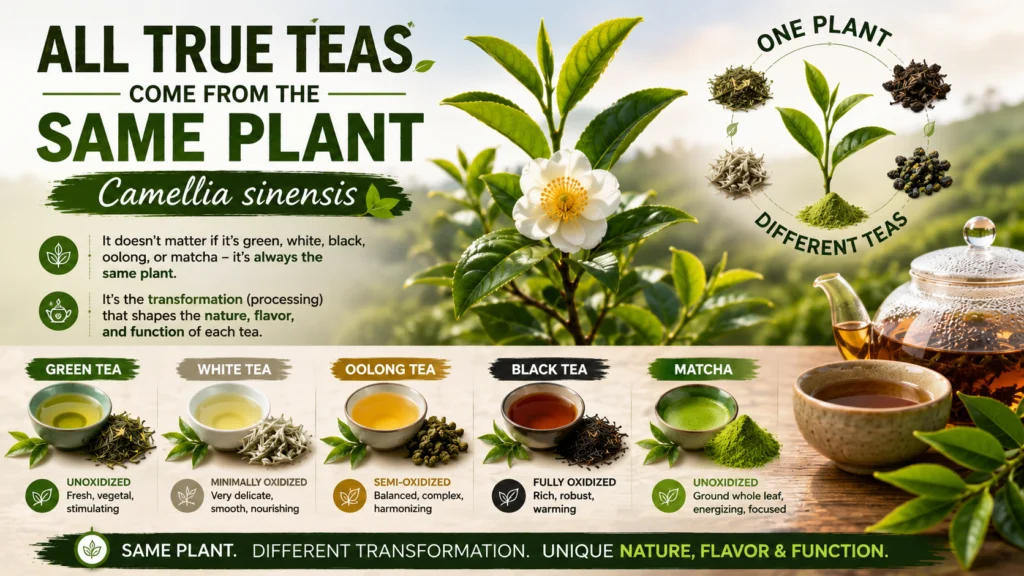
One of the biggest misconceptions is that every tea comes from a different plant.
In reality, all true teas come from a single plant: Camellia sinensis.
That includes:
- Green tea
- White tea
- Oolong tea
- Black tea
- Matcha
- Pu-erh tea
What makes them different isn’t the plant itself. It’s how the leaves are processed after they’re harvested.
The degree of oxidation and fermentation changes each tea’s energetic temperature, flavor, and therapeutic function.
Herbal teas, on the other hand, aren’t technically teas at all. They’re infusions made from herbs, flowers, roots, spices, or berries and naturally contain no caffeine.
Understanding this distinction helps practitioners make much more targeted recommendations.
Green Tea: Cooling Heat and Supporting Digestion
Green tea has become part of my own morning ritual. While my husband enjoys coffee, you’ll usually find me sipping jasmine green tea.
According to TCM, green tea has a cooling nature with a bitter and slightly sweet flavor.
This combination allows it to:
- Clear Heat
- Cool the Liver
- Promote digestion
- Help dry Dampness
Green tea is an excellent choice for patients presenting with excess Heat patterns, Liver Fire, irritability, or internal Heat.
However, because of its cooling nature, it isn’t ideal for patients with Yang deficiency, cold digestion, or significant fatigue. The bitter flavor can also be too draining for someone with a weak Spleen Qi.
Black Tea: A Gentle Yang Tonic
Black tea sits on the opposite end of the spectrum.
Instead of cooling, it has a warming energetic nature, making it much more appropriate for patients who tend to feel cold.
Its flavor is primarily sweet with a slight bitterness, allowing it to:
- Warm the Stomach
- Support Yang
- Tonify the Heart
- Promote healthy digestion
For patients who wake up feeling cold, sluggish, or have weak digestive fire, black tea can provide a gentle morning boost without being overly stimulating.
White Tea: Cooling Without Being Too Cold
White tea is often overlooked, but it’s one of my favorite recommendations for patients who need gentle cooling.
Its energetic nature is cool, although noticeably milder than green tea.
Because its flavor is primarily sweet, white tea helps:
- Nourish Yin
- Clear Heat
- Gently cool the body
It’s a wonderful choice for Yin-deficient patients who run warm but don’t tolerate the stronger cooling effects of green tea.
Oolong Tea: Moving Stagnation
Oolong sits somewhere between green and black tea, both in processing and energetics.
Its slightly warming nature, combined with an equal balance of bitter and sweet flavors, makes it especially useful for moving stagnation.
In Chinese medicine, oolong helps:
- Move Liver Qi
- Resolve Phlegm
- Support digestion
Patients who feel emotionally “stuck,” experience stress-related digestive complaints, or carry tension throughout their bodies often do very well with oolong tea.
Pu-erh Tea: Drying Dampness
Pu-erh is a fermented tea prized throughout Asia.
The longer it ages, the warmer and more grounding it becomes.
Its deep earthy flavor reflects its primary actions:
- Strengthens the Spleen
- Resolves Dampness
- Improves digestion
- Clears mental fog
If a patient complains of feeling heavy after meals, sluggish, or mentally foggy, Pu-erh can be an excellent daily tea recommendation.
Matcha: Concentrated Green Tea
Matcha has exploded in popularity over the past decade, appearing in cafés around the world.
Energetically, it behaves very similarly to green tea, but with greater intensity.
Because you’re consuming the entire powdered tea leaf rather than simply steeping it, matcha offers:
- Stronger Heat-clearing properties
- More Liver-soothing effects
- Greater mental focus
- Much higher caffeine content
For patients with Liver Yang Rising, anxiety, or insomnia, too much matcha may actually aggravate their symptoms.
As always, pattern differentiation comes first.
Genmaicha: A Gentle Alternative
Genmaicha combines green tea with roasted rice.
The roasted rice softens green tea’s cooling nature, making it easier on digestion.
It helps:
- Harmonize the Middle Jiao
- Strengthen the Spleen
- Support digestion without excessive cooling
It’s a wonderful compromise for patients who enjoy green tea but struggle with weak digestion.
Understanding Caffeine Through the Lens of TCM
Patients often ask which tea contains the most caffeine.
Many assume darker tea equals more caffeine, but that’s not necessarily true.
Generally speaking:
- Matcha contains the highest caffeine.
- Black tea comes next.
- Oolong contains a moderate amount.
- Green tea is relatively low.
- White tea is typically the lowest.
- Pu-erh and Genmaicha vary depending on processing.
From a Chinese medicine perspective, caffeine naturally moves Qi upward and outward.
That means patients experiencing:
- anxiety
- insomnia
- Liver Yang Rising
- excessive Heat
- sympathetic nervous system activation
may benefit from reducing high-caffeine teas, particularly later in the day.
This is a simple but valuable question to include during your patient intake.
Herbal Teas: Targeted Therapeutic Support
Unlike true teas, herbal teas don’t come from Camellia sinensis.
Instead, they’re made from flowers, herbs, roots, fruits, and spices, allowing for much more targeted therapeutic actions.
Ginger Tea
One of my personal favorites during winter is ginger tea.
Its warming, pungent nature makes it ideal for:
- Cold digestion
- Nausea
- Morning sickness (when accompanied by Cold)
- Spleen Yang deficiency
- Cold uterine conditions
However, patients with Heat patterns may respond much better to cooling herbs like mint instead.
Goji Berry Tea
Goji berries (Gou Qi Zi) create a wonderfully gentle tonic.
They help:
- Nourish Liver Yin
- Nourish Kidney Yin
- Benefit the eyes
- Support patients who spend long hours on computers
It’s an excellent everyday tea for Yin deficiency.
Mint and Peppermint
Although many people use these interchangeably, they’re quite different energetically.
Mint is gently cooling and helps:
- Move Liver Qi
- Clear mild Heat
- Harmonize the Stomach
Peppermint is much colder and stronger.
It’s particularly useful for:
- Wind Heat
- Sore throat
- Headaches
- Liver Fire
Because of its colder nature, peppermint should be used more cautiously in patients with Yang deficiency.
Chrysanthemum Tea
Chrysanthemum flower tea is one of my favorite recommendations for patients with Liver Yang Rising.
Its actions include:
- Clearing Liver Heat
- Calming rising Yang
- Benefiting the eyes
- Supporting healthy blood pressure
For patients with dry eyes caused by Liver Yin deficiency combined with Liver Yang Rising, combining chrysanthemum with goji berries creates a beautiful balance.
Rooibos Tea
Although rooibos isn’t traditionally part of Chinese herbal medicine, I frequently recommend it.
It’s naturally caffeine-free, mildly warming, and extremely gentle on digestion.
Patients who need to reduce caffeine but still enjoy the ritual of tea often love rooibos.
Licorice Root Tea
Licorice root (Gan Cao) is neutral and sweet.
Its primary role is to:
- Tonify Spleen Qi
- Harmonize formulas
- Support digestion
One important precaution: patients with high blood pressure should avoid large amounts of licorice root.
Dandelion Tea
Dandelion is one of the coldest herbs discussed today.
It powerfully:
- Clears Heat
- Drains Damp Heat
- Supports the Liver and Gallbladder
- Encourages detoxification
Because of its strong cooling action, it isn’t appropriate for patients with Yang deficiency or internal Cold.
Chai Tea
Nothing says winter quite like a warm cup of chai.
Its combination of cinnamon, ginger, cloves, and cardamom creates a beautifully warming tea that helps:
- Warm the Middle Jiao
- Support Yang
- Improve circulation
- Ease cold digestion
It’s an ideal recommendation for patients who always seem to be cold.
Matching Tea to Common TCM Patterns
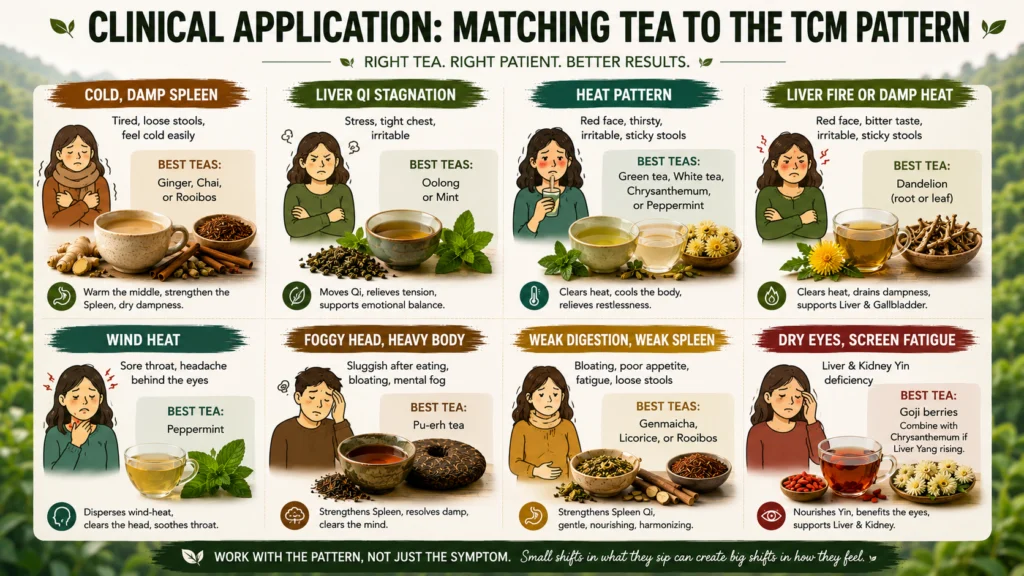
One of the easiest lifestyle recommendations we can give patients is simply helping them choose the tea that best matches their pattern.
Here are some practical examples:
Cold Damp or Spleen Yang Deficiency
- Ginger tea
- Chai
- Rooibos
Liver Qi Stagnation
- Oolong
- Mint tea
Heat Patterns
- Green tea
- White tea
- Chrysanthemum
- Peppermint
Liver Fire or Damp Heat
- Dandelion tea
Wind Heat
- Peppermint
Dampness and Mental Fog
- Pu-erh tea
Weak Digestion
- Genmaicha
- Rooibos
- Licorice root
Liver and Kidney Yin Deficiency
- Goji berry tea
- Goji berry with chrysanthemum
Sometimes the smallest recommendation in simply changing what’s already in a patient’s mug can reinforce everything else you’re doing in treatment.
Final Thoughts
Tea is far more than just a comforting beverage.
In Traditional Chinese Medicine, it’s another therapeutic tool we can use to gently influence the body’s internal balance every single day.
Whether you’re helping a patient cool Liver Fire, strengthen the Spleen, nourish Yin, or move stagnant Qi, choosing the right tea allows treatment to continue long after they leave the clinic.
As always, remember that no tea is universally “healthy.” The best tea is the one that matches the individual in front of you.
That’s the beauty of Chinese medicine.
The next time you reach for your favorite cup of tea, remember that you’re doing much more than enjoying a warm drink. Every tea has its own energetic nature, flavor, and therapeutic action that can either support or challenge your body’s current state.
By understanding tea through the lens of Traditional Chinese Medicine, you can make simple daily choices that complement your treatments, improve digestion, balance your constitution, and help your patients feel better one cup at a time. Sometimes, the smallest changes create the biggest impact.
Share this article