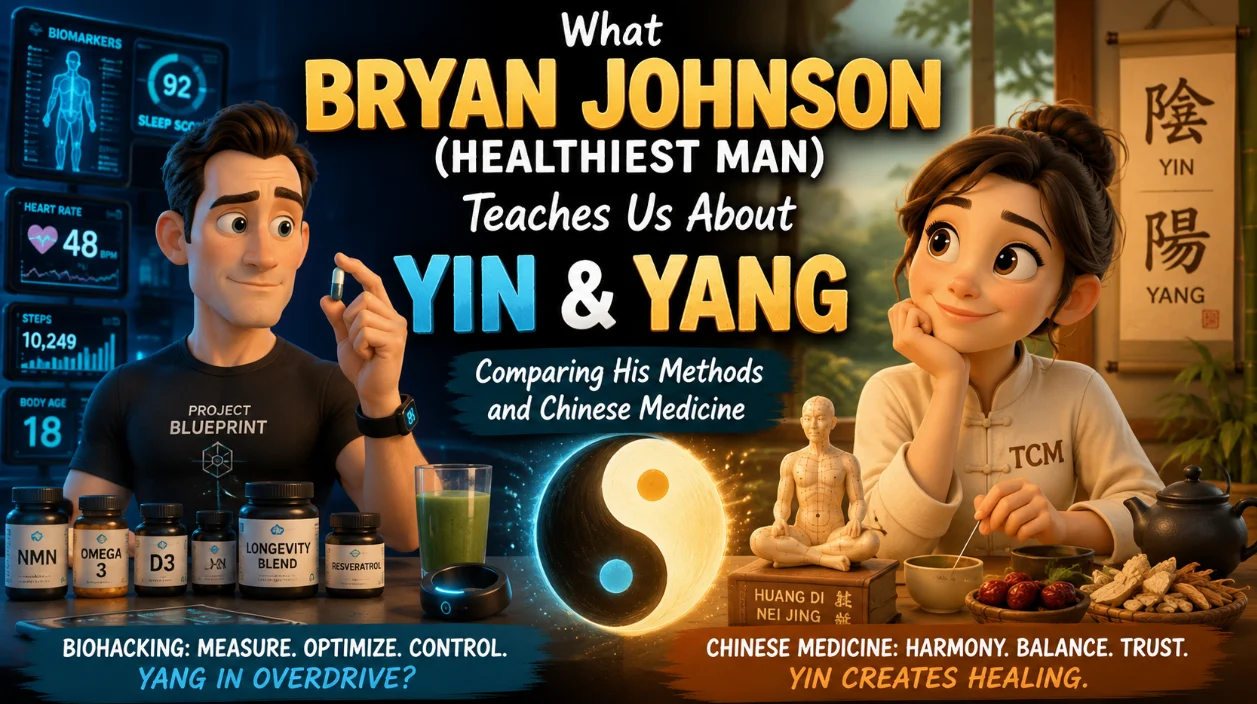
#134 – What Bryan Johnson (Healthiest Man) Teaches Us About Yin and Yang (Podcast)
Listen on Apple Podcasts Listen on Spotify Listen on Amazon Music
🔗 Links mentioned in this episode:
📗 Get your copy of Chinese Medicine Made Easy Book or PDF!
💌 Sign up to my FREE newsletter here
🩵 Curious if Jane is right for your practice? Book a free demo and get a one-month grace period with code ACUPRO1MO!
☯️ More AcuPro Episodes you’ll love:
Exploring the Intricacies of Yin Yang in Chinese Medicine
Circadian Rhythms in Chinese Medicine
Gut Health in Naturopathic Medicine & Chinese Medicine with Dr. Alex Dragan
What Bryan Johnson Teaches Us About Yin and Yang
We’re living in a world obsessed with numbers.
How many steps did you take today? What was your sleep score last night? How low is your resting heart rate? Did you hit your protein goal? Is your HRV improving?
Technology has made it easier than ever to measure almost every aspect of our health. For many people, that information is incredibly helpful. But at what point does tracking our health become more stressful than healing?
That question came to mind after hearing recent news about Bryan Johnson: the entrepreneur behind Project Blueprint and arguably the world’s most famous biohacker.
Despite spending millions of dollars each year monitoring every imaginable health metric, Bryan Johnson recently shared that he has been diagnosed with autoimmune gastritis. His own words were striking: “My stomach is eating itself.”
As practitioners of Chinese Medicine, this story opens the door to a fascinating conversation. Not about criticizing biohacking, but about balance.
Because if there’s one principle that Chinese medicine has taught us for thousands of years, it’s this:
Health isn’t found by maximizing one side of life. It’s found by balancing Yin and Yang.
Bryan Johnson’s Quest for Perfect Health
If you aren’t familiar with Bryan Johnson, here’s the short version.
After selling his technology company for hundreds of millions of dollars, he dedicated his life to slowing (or even reversing) the aging process.
His daily routine is astonishingly structured.
He eats virtually the same carefully measured meals every day, follows a strictly monitored plant-based diet, takes well over 100 supplements daily, undergoes constant blood work and imaging, tracks his sleep with incredible precision, and measures everything from body composition to cognitive performance.
There is no shortage of discipline.
Yet despite all of that data, his body quietly developed autoimmune gastritis over many years.
The only early clue? Slowly declining iron levels.
It raises an important question.
Can we become so focused on measuring health that we forget to actually experience it?
The Modern World Lives in Yang
From a TCM perspective, what fascinates me isn’t Bryan Johnson himself.
It’s what he represents.
- Our culture celebrates constant optimization.
- Work harder.
- Train harder.
- Measure more.
- Improve more.
- Never stop.
That is pure Yang energy.
Yang is:
- Movement
- Achievement
- Action
- Absolutely necessary
Without Yang, nothing gets accomplished. But Yang without Yin eventually becomes imbalance.
Yin reminds us to :
- pause
- rest
- recover
- trust the body
- allow healing instead of constantly forcing improvement
When every waking moment becomes another opportunity to optimize ourselves, we may unknowingly lose the very balance we’re chasing.
When Health Metrics Become an Obsession
I once had a patient tell me she refused to go to bed unless her fitness watch displayed exactly 10,000 steps. If she was sitting at 9,900? She would pace around her bedroom until the number changed. Not because her body needed movement. Because her app did. That’s no longer using technology as a helpful tool. The technology is now controlling the person. As practitioners, we’re seeing this more frequently.
Patients can recite:
- their average sleep score
- resting heart rate
- protein intake
- calorie count
- HRV
- daily step count
Yet when we ask one simple question, “How are you actually feeling today?” They often struggle to answer. That disconnect is where Yin begins to disappear.
What TCM Can Teach Us About Bryan Johnson’s Diagnosis
One of the most interesting aspects of Bryan Johnson’s diagnosis is where it occurred: the stomach. In Traditional Chinese Medicine, the Spleen and Stomach are considered the center of health. Together they are responsible for transforming food into Qi and Blood while nourishing every organ system. But they digest far more than food.
According to Chinese medicine, they also process:
- thoughts
- studying
- concentration
- worry
- overthinking
- obsessive thinking
The emotional aspect associated with the Spleen is called the Yi—our thinking mind. Healthy Yi allows us to focus. Imbalanced Yi becomes rumination, worry, perfectionism, and obsession. Again, I’m not suggesting Bryan Johnson’s thoughts caused his illness. None of us could make that claim. But it’s fascinating that someone whose entire life revolves around monitoring, analyzing, and improving his own body develops a condition affecting the organ system most associated with digestion, overthinking, and self-focus. It’s an interesting lens through which to view health.
Western Medicine and Chinese Medicine Meet in the Middle
Autoimmune gastritis damages the stomach’s ability to produce intrinsic factor and stomach acid. Over time, this makes it difficult to absorb nutrients like Vitamin B12 and Iron. Sound familiar?
In TCM, when the Spleen and Stomach become deficient, they lose their ability to transform and transport nutrients efficiently. Poor absorption leads to Qi deficiency. Qi deficiency eventually affects Blood production. Different language, same observation. This is one of those beautiful moments where modern physiology and Traditional Chinese Medicine arrive at remarkably similar conclusions.
Sometimes More Supplements Aren’t the Answer
One of the biggest takeaways from Bryan Johnson’s story is that even the highest-quality nutrition can’t fully compensate for poor digestion and absorption.
This is something we see regularly in clinic. Patients arrive carrying bags full of supplements, yet they’re exhausted. Bloated. Foggy-headed. Deficient. Sometimes they don’t need another capsule. Sometimes they need to strengthen the digestive system first.
In TCM, supporting the Spleen and Stomach often becomes the foundation before adding anything else. After all, even the best nutrients can’t nourish the body if they aren’t being properly absorbed.
Nature Still Matters
One part of Bryan Johnson’s routine particularly stood out to me. Many of the things he carefully engineers already exist naturally. Instead of getting sunlight, he relies heavily on red-light therapy.
Instead of simply spending time outdoors, much of his environment is highly controlled indoors. Technology absolutely has its place. But Chinese medicine has always reminded us that healing begins with reconnecting to nature. Simple habits still matter.
Things like:
- spending time outside each day
- allowing natural sunlight to regulate your circadian rhythm
- breathing fresh air
- moving your body outdoors
- eating seasonal foods
Sometimes the most powerful medicine isn’t the most expensive.
Sometimes it’s simply returning to what our bodies evolved alongside.
The Missing Piece: The Shen
Watching Bryan Johnson’s documentaries and interviews, one thing stood out to me.
There’s endless discussion about biology. Very little discussion about joy. Or relationships, purpose, community, or emotional wellbeing.
In Chinese medicine, the Heart houses the Shen: our spirit, consciousness, and emotional presence.
You can optimize every lab value imaginable.
But if the Shen isn’t nourished, something important is still missing.
Health isn’t simply about living longer.
It’s about living well.
What This Means for Our Patients
As acupuncturists and TCM practitioners, we’re going to see more patients arriving with wearable technology, health apps, and endless streams of biometric data. Those tools can absolutely be helpful, but they should never replace body awareness. One of the greatest gifts we offer isn’t another number. It’s helping patients reconnect with themselves.
Helping them notice:
- how their digestion feels
- how rested they actually are
- what emotions they’re carrying
- what their body has been trying to communicate all along
Sometimes the most healing question isn’t:
“How many hours did you sleep?”
It’s simply:
“How do you feel?”
That question brings patients back into Yin. Back into presence and into themselves.
Final Thoughts
Bryan Johnson’s story isn’t a failure of biohacking. It’s a reminder that no amount of technology can replace balance. Chinese medicine has never rejected science or innovation. Instead, it reminds us that health isn’t found in endless optimization. It’s found in harmony. Yang gives us discipline, movement, and progress. Yin gives us restoration, trust, and wisdom. When both work together, true healing becomes possible. Maybe that’s the lesson this story offers all of us, not only as practitioners, but as human beings trying to live healthier lives.
So the next time you check your smartwatch or glance at your latest health metric, take one extra moment to ask yourself something your devices never can: “How do I actually feel today?”
That answer might be the most valuable health data of all.
Modern technology gives us incredible tools to better understand our health, but numbers alone can never tell the whole story. Traditional Chinese Medicine reminds us that true wellness comes from balancing action with rest, measurement with intuition, and Yang with Yin.
As practitioners, we have a unique opportunity to help our patients reconnect with their bodies, not just through lab values or wearable devices, but through awareness, presence, and trust. Sometimes the greatest healing begins when we stop trying to optimize every moment and simply listen to what our bodies have been trying to tell us all along.
Disclaimer
The Acupro Show podcast and material shared through Acupro Academy, which is a subdivision of Natural Health Sense Incorporated. Designed solely for educational and entertainment purposes. The utilization of information from this podcast or any associated material is at the user’s discretion and risk. This content is not meant to replace the guidance of an acupuncturist. Nor a Chinese medicine doctor, medical doctor, physician, or any qualified professional. It is not a substitute for proper diagnosis or treatment. Users are strongly advised not to ignore or postpone seeking medical advice for any existing medical condition with their healthcare professional, regarding any health concerns.
Need the podcast transcript? Click here!
Share this article