
TOP 5 Large Intestine Channel Acupuncture Points You Need to Use in Practice
If you’re studying acupuncture or working in clinical practice, you know there are certain large intestine acupuncture points that you reach for again and again.
The Large Intestine meridian has 20 acupuncture points, but today I want to share five of my favorite and most powerful Large Intestine points and explain why I keep coming back to them in practice.
And yes, you probably guessed that Large Intestine 4 made the list! But there are a few other points here that might surprise you.
We’ll look at what makes each point clinically useful, how I like to combine them with other acupuncture points, and I’ll finish with one of my favorite combinations for constipation.
Let’s do this!
Clara
TCM Geek
Links mentioned in this video:
💌 Sign up to my FREE newsletter here!
📙 Get your copy of AcuPoints Made Easy Book or PDF!
📍 Get your AcuPoints Clinical Shortcuts Guide here!
🩵 Curious if Jane is right for your practice? Book a free demo and get a one-month grace period with code ACUPRO1MO!
The 5 Most Powerful Large Intestine Acupuncture Points You Need to Know
Why the Large Intestine Meridian Is So Useful
The Large Intestine channel is a Yangming meridian that travels from the index finger up the arm, through the shoulder and neck, and eventually reaches the face.
Because of this pathway, many Large Intestine points have a strong clinical relationship with the head, face, throat, nose, and upper body.
The channel also has important relationships with heat, qi and blood movement, and conditions involving the nose and digestive system.
Understanding the pathway of a meridian is one of the easiest ways to start remembering why certain points are useful.
Instead of simply memorizing a long list of indications, ask yourself:
Where does this channel go? What type of point is this? And what is its main function?
That approach makes acupuncture point selection much easier.
Large Intestine 4: The Commander of the Face
Let’s start with the obvious one: Large Intestine 4.
LI 4 is located on the back of the hand, between the first and second metacarpal bones.
This is one of those acupuncture points that almost every student learns early in their TCM education—and for good reason.
One of its major clinical roles is as the commander point of the face.
Because of this, LI 4 can be incredibly useful for a wide variety of facial conditions, including:
- Jaw pain
- Sinus problems
- Eye issues
- Facial pain
- Headaches
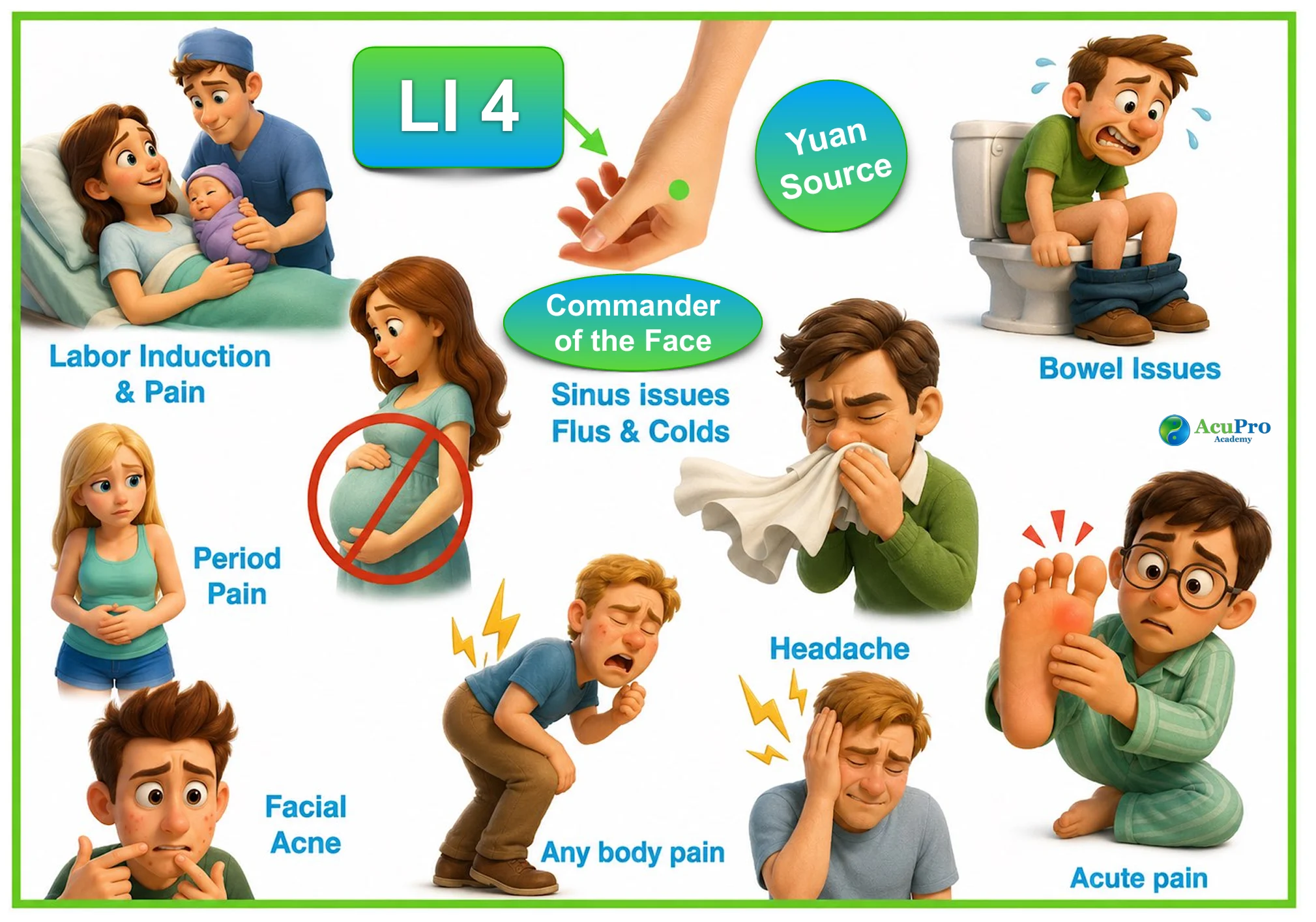
But LI 4 isn’t only about the face.
It’s also a powerful point for moving qi and blood and relieving pain throughout the body.
This is one reason you’ll see it used in so many different acupuncture treatments.
LI 4 + Lung 7
One combination I particularly like is LI 4 with Lung 7.
Think about the pathways of these two channels. When you’re treating headaches that travel from the forehead toward the back of the head, this combination can be especially useful for moving the qi along the channels.
And of course, when you’re selecting points clinically, you always want to come back to your diagnosis rather than simply treating a symptom.
Important pregnancy consideration
LI 4 is traditionally considered contraindicated during pregnancy, so practitioners should use appropriate caution and clinical judgment.
This is a great reminder that even the most commonly used acupuncture points need to be selected appropriately for the individual patient.
Large Intestine 6: A Hidden Gem for the Upper Body
My second choice is Large Intestine 6.
It’s located three cun above LI 5 and is the Luo-connecting point of the Large Intestine channel.
LI 6 is one of those points that students sometimes overlook because it doesn’t have the same celebrity status as LI 4 or LI 11.
But clinically, it can be incredibly useful.

One of the applications I particularly like is for edema affecting the upper body and face, especially when environmental allergies are involved.
Think about the patient who comes in with seasonal allergies and is experiencing congestion, puffiness, or swelling around the face.
LI 6 can become a useful part of your treatment strategy.
LI 6 + Lung 7
I also like pairing LI 6 with Lung 7.
Remember that the Large Intestine and Lung are paired channels. LI 6 is the Luo-connecting point of the Large Intestine, while Lung 7 is the Luo-connecting point of the Lung.
This gives you another way to think about the relationship between these two channels rather than memorizing each point in isolation.
Large Intestine 11: Your Go-To Heat-Clearing Point
Next up is one of the major workhorses of the Large Intestine channel: Large Intestine 11.
LI 11 is located at the elbow crease and is the He-Sea point of the Large Intestine channel.
If you need to remember one major function of LI 11, remember:
Heat.
LI 11 is one of the points I think of when I want to clear internal or external heat.
This makes it useful for conditions such as:
- Fever
- Sore throat
- Heat-related presentations
- Certain inflammatory or digestive complaints associated with heat
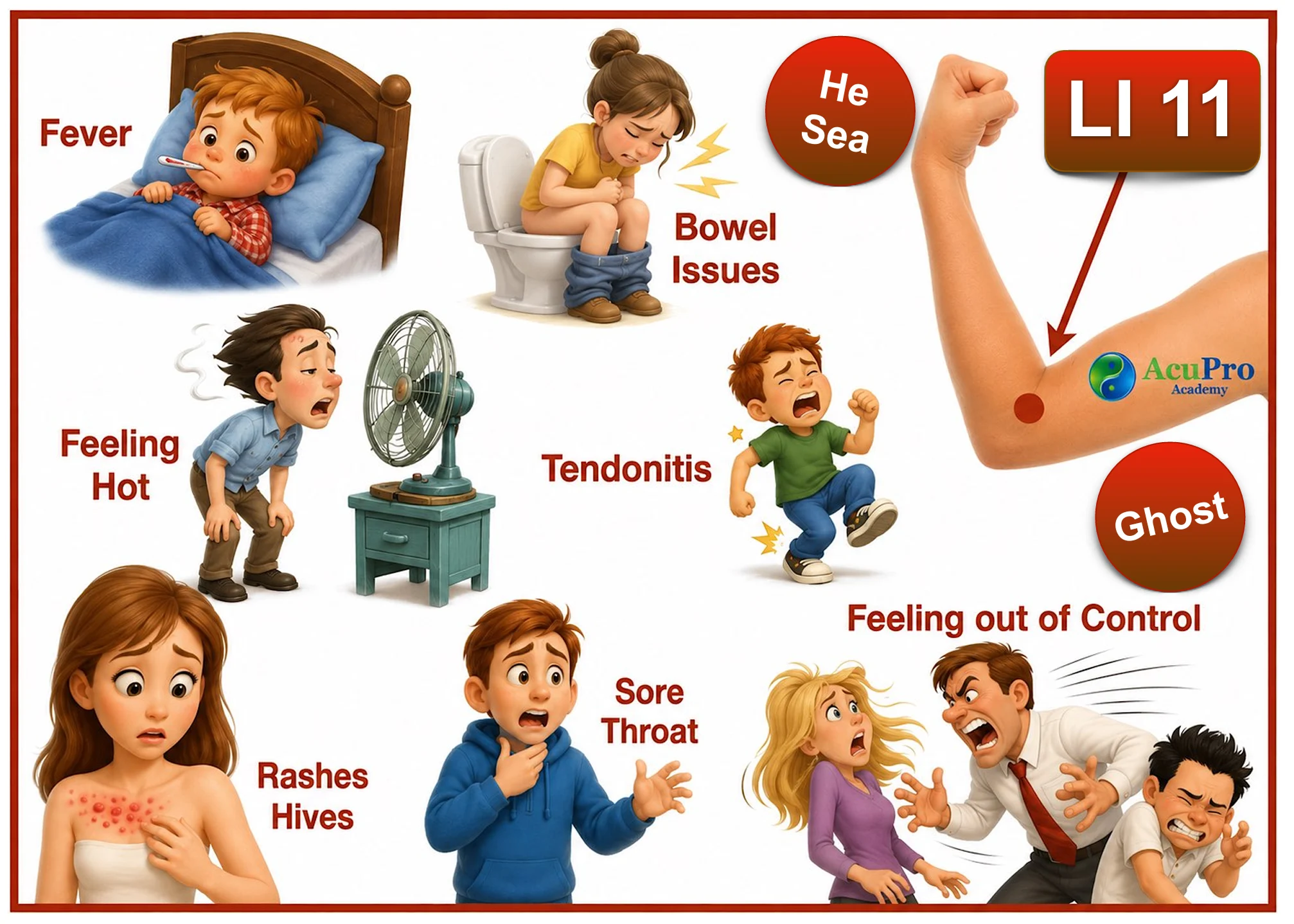
It can also be incorporated into treatments for diarrhea when emotional stress and heat are part of the picture.
Again, diagnosis is key.
The presence of diarrhea alone doesn’t automatically mean LI 11 is the right point. You need to understand why the patient has diarrhea and what pattern is underneath it.
That’s one of the things I love about TCM: the symptom is only the beginning of the investigation.
Large Intestine 14, LI 15 & Jian Xin: The Shoulder Team
Technically, this is a little different from the other choices because I’m grouping several points together, but I couldn’t talk about the Large Intestine channel without mentioning its incredible usefulness for shoulder pain.
My favorite combination includes:
- Large Intestine 14
- Large Intestine 15
- Jian Xin
- LI 4
- LI 11
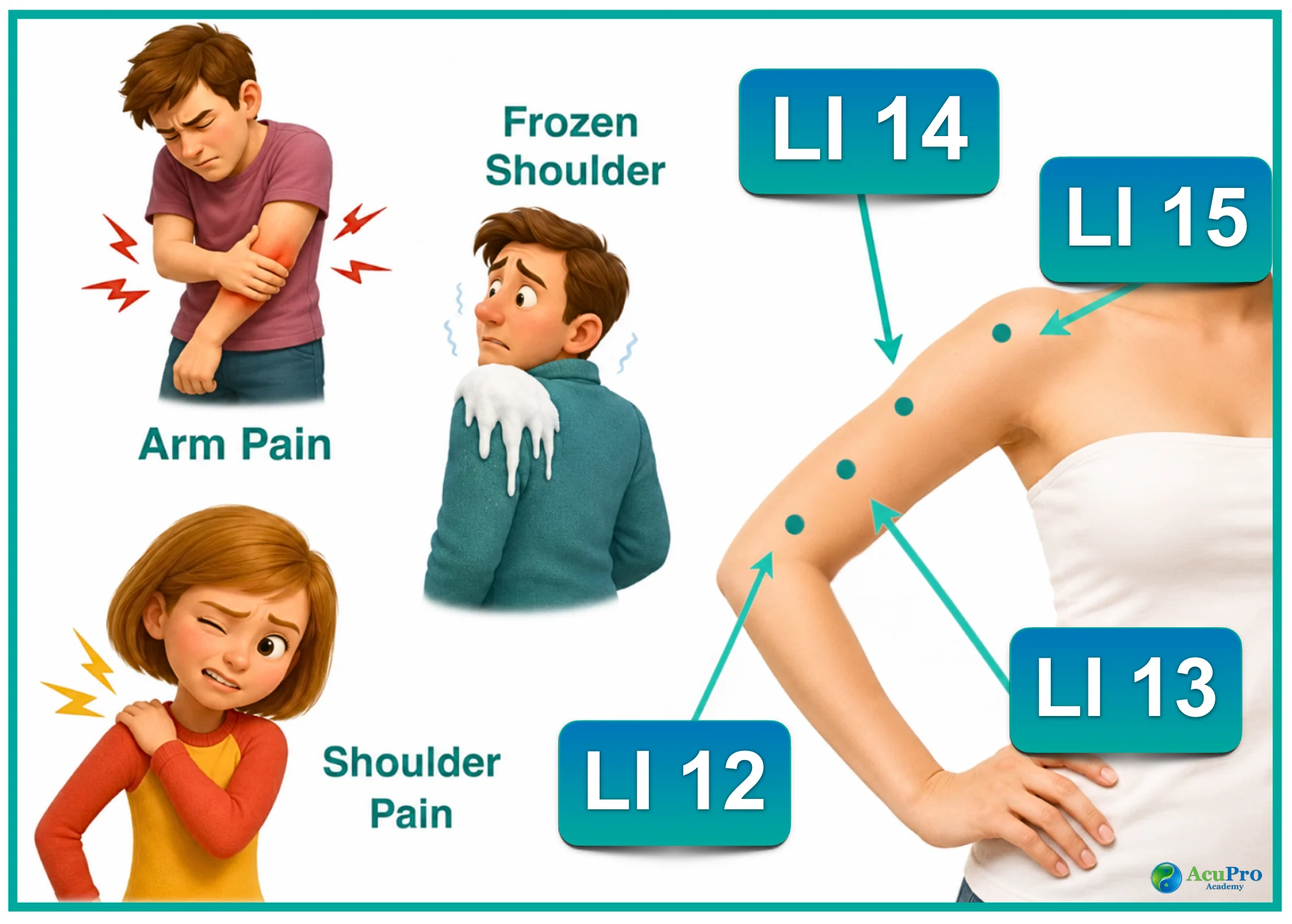
This combination can be particularly useful when treating shoulder problems, including restricted movement and frozen shoulder presentations.
Why does the Large Intestine channel work so well here?
Because the channel travels directly through the shoulder region.
This is a perfect example of why knowing your meridian pathways matters.
When you understand where the channel travels, point selection becomes much more intuitive.
Don’t forget cupping
For shoulder pain with significant stagnation and muscular restriction, I also like incorporating cupping into the treatment when appropriate.
The goal isn’t simply to throw as many techniques and points as possible at the patient.
Instead, think about what you’re trying to accomplish:
Where is the stagnation? Where is the restriction? What needs to move?
Then build your treatment around that clinical picture.
Large Intestine 20: Open the Nose
My fifth choice is Large Intestine 20.
LI 20 is located beside the nose and is one of those points where its location immediately gives you a clue about its function.
It is fantastic for opening the nose.
That makes it useful for problems such as:
- Nasal congestion
- Difficulty breathing through the nose
- Loss of smell
- Nasal obstruction

This can be particularly interesting for patients who experience a loss of smell following an illness such as COVID-19.
Once again, the meridian pathway gives us a helpful framework.
The Large Intestine channel travels directly toward the nose and face, so it makes sense that the terminal point of the channel has such a strong local action in this area.
Bonus: My Favorite Acupuncture Combination for Constipation
And now for the bonus combination I promised!
When treating constipation, one of the first points I think about is Stomach 36.
ST 36 is a foundational digestive point and can be incredibly useful when supporting the digestive system.
I also like what I call the Digestive Diamond:
- Stomach 25
- Ren 9
- Ren 6
Then we can modify the treatment depending on whether we’re dealing with an excess or deficiency presentation.
Constipation from excess
For an excess pattern, LI 4 can be a great addition because of its ability to move qi and blood.
Constipation from deficiency
If the constipation is related to deficiency, I may consider Kidney 6 instead.
And another point I really like for constipation is San Jiao 6.
The important takeaway is that we shouldn’t treat every patient with constipation using the exact same acupuncture prescription.
Ask yourself:
Is this excess or deficiency? Is there heat? Is there qi stagnation? Is there dryness? What does the patient’s tongue and pulse tell me?
That’s where TCM diagnosis turns a collection of acupuncture points into an individualized treatment.
The Takeaway
The Large Intestine meridian is packed with incredibly useful acupuncture points.
If I had to narrow it down to my favorites, I’d start with:
LI 4 for the face, pain, and moving qi and blood.
LI 6 for upper-body and facial edema, particularly when allergies are involved.
LI 11 for clearing heat.
LI 14, LI 15 and Jian Xin for shoulder problems.
And LI 20 for opening the nose and addressing nasal congestion or loss of smell.
But remember: knowing the indications for a point is only one piece of the puzzle.
The real skill comes from understanding the meridian pathway, point category, TCM diagnosis, and the individual patient in front of you.
That’s what takes you from memorizing acupuncture points to actually thinking like a practitioner.
If you’re studying acupuncture or simply want to deepen your knowledge of the meridians, make sure you check out my other videos and playlists where we dive into the different channels and their most useful acupuncture points.
Keep learning, keep practicing, and as always…
Keep rocking it with TCM!
Share this article

Written by : AcuPro Academy (Clara)
Related Posts






Latest articles

November 3, 2026

November 3, 2026