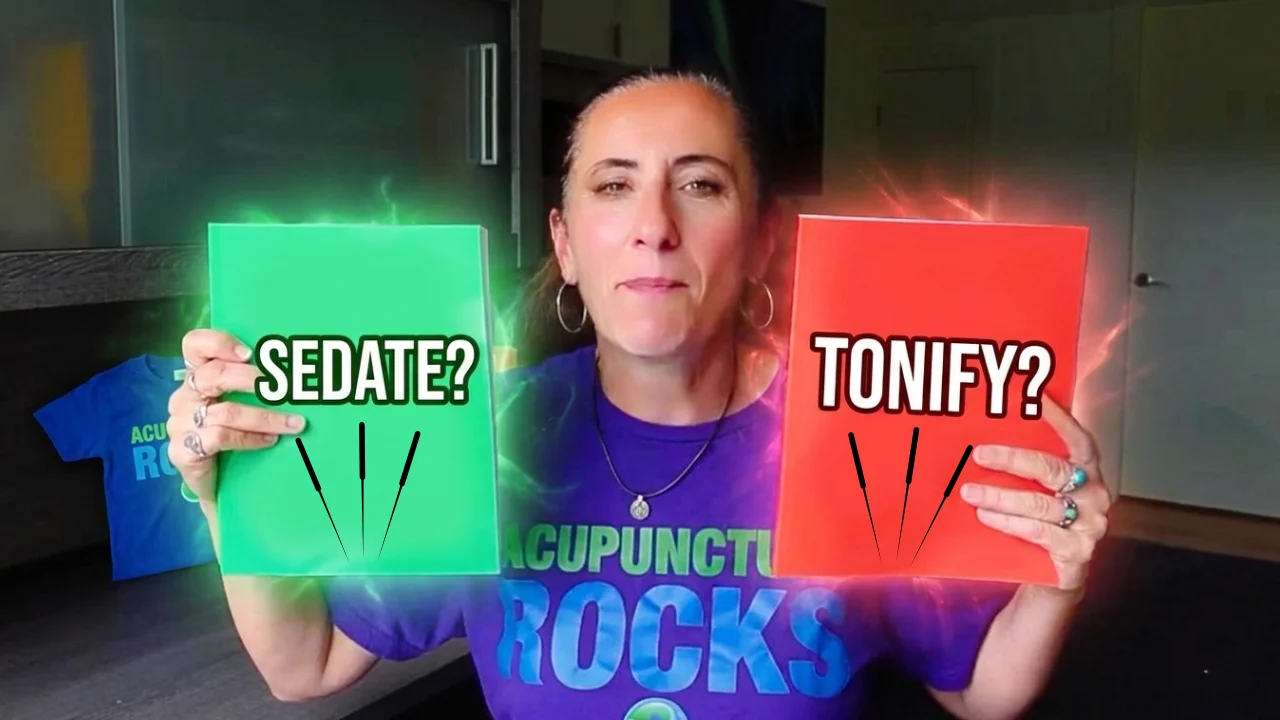
Sedate or Tonify Needle Stimulation
Have you ever opened an acupuncture textbook, looked at a treatment protocol online, or attended a seminar and suddenly thought, “Wait… am I supposed to tonify this point or sedate it?” If so, you are absolutely not alone. In fact, this is one of the most common questions I hear from both acupuncture students and practitioners.
And honestly? It makes sense.
Most of us learned point functions, indications, and protocols in school, but many practitioners never received enough practical training on how to needle according to the pattern in front of them. Yet understanding when to sedate and when to tonify can completely change the effectiveness of your treatments.
The good news is that once you understand the foundations of excess versus deficiency patterns, everything becomes much clearer.
Let’s do this!
Clara
TCM Geek
Links mentioned in this episode:
 Sign up to my FREE newsletter here
 Get your copy of Chinese Medicine Treatments Made Easy here
🩵 Curious if Jane is right for your practice? Book a free demo and get a one-month grace period with code ACUPRO1MO!
Which Acupuncture Points to Sedate vs Tonify?
Start with the Diagnosis First
Before deciding whether to tonify or sedate, we always need to identify the pattern. This is the key.
Acupuncture is not about blindly following protocols or using the same technique on every patient. The diagnosis determines the treatment principle, and the treatment principle determines the needle technique.
In TCM, excess patterns generally require reducing or sedating techniques, while deficiency patterns need strengthening or tonifying methods.
Simple in theory… but in practice, most patients actually present with mixed patterns.
For example, someone may have:
- Liver qi stagnation (excess)
- Combined with spleen qi deficiency (deficiency)
This is incredibly common in clinic. Stress creates stagnation, and over time that stagnation weakens digestion, energy, and blood production.
That means some points in the treatment should reduce excess, while others should nourish and support deficiency.
This is why diagnosis matters so much.
Understanding Excess vs. Deficiency
One of the easiest ways to improve your treatments is to learn how to quickly recognize whether symptoms are primarily excess or deficiency in nature.
Deficiency Patterns
Deficiency patterns tend to look weak, empty, tired, or depleted.
Common deficiency signs include:
- Fatigue
- Weak voice
- Low energy
- Poor appetite
- Pale complexion
- Thin or weak pulse
- Symptoms that improve with pressure or rest
Patients with deficiency patterns often crave support, warmth, rest, and nourishment.
Common deficiency conditions:
- Spleen qi deficiency
- Blood deficiency
- Kidney yin deficiency
- Kidney yang deficiency
Excess Patterns
Excess patterns tend to be louder, stronger, fuller, or more intense.
Common excess signs include:
- Loud voice
- Irritability or agitation
- Strong pain
- Big, forceful pulse
- Heat signs
- Symptoms worsened by pressure
Patients with excess conditions often feel overwhelmed by too much stimulation or internal accumulation.
Common excess conditions:
- Liver fire
- Liver yang rising
- Damp heat
- Qi stagnation
- Phlegm accumulation
A helpful clinical pearl:
- Deficiency patients often enjoy massage and pressure.
- Excess patients frequently dislike too much touch because it feels overwhelming or aggravating.
Sedating Techniques in Acupuncture
Sedating techniques are used to reduce excess conditions, move stagnation, calm rising energy, and clear pathogenic factors.
Think of it as helping the body release what it no longer needs.
General Sedating Methods
Needle Insertion
- Insert quickly
- Withdraw slowly
- Leave the hole open afterward to allow qi to disperse
Needle Direction
- Needle against the direction of the meridian flow
Rotation Technique
- Use larger, stronger, faster rotations
- Often counter clockwise rotations are used in traditional teachings
Common Goals of Sedation
- Clear heat
- Reduce pain
- Move stagnation
- Calm agitation
- Descend rising yang
Example Points Often Sedated
- Liver 2 for liver fire
- Large Intestine 4 for pain and excess conditions
- Gallbladder 20 for liver yang rising
- Stomach 44 for excess stomach heat
Sedating can be especially powerful in acute situations where symptoms are intense and overwhelming.
Tonifying Techniques in Acupuncture
Tonifying techniques are designed to strengthen, nourish, build, and support the body’s resources.
This approach is often gentler and more supportive.
General Tonifying Methods
Needle Insertion
- Insert slowly
- Withdraw quickly
- Close the hole afterward with cotton or gentle pressure to “keep the qi in”
Needle Direction
- Needle in the direction of the meridian flow
Rotation Technique
- Small, gentle rotations
- Often clockwise rotations are used traditionally
Common Goals of Tonification
- Boost qi
- Nourish blood
- Strengthen digestion
- Support recovery
- Build constitutional weakness
Example Points Often Tonified
- Stomach 36 for Qi and Digestion
- Spleen 6 for Yin and Blood
- Ren 6 for original Qi
- Kidney 3 for Kidney deficiency
- Lung 9 for Lung Qi deficiency
Tonification is especially important in chronic conditions, fatigue, recovery states, infertility, burnout, and aging-related conditions.
What About Mixed Patterns?
This is where acupuncture becomes both an art and a science.
Most patients are not purely excess or purely deficient.
A stressed, exhausted patient is a perfect example:
- The stress creates liver qi stagnation (excess)
- The exhaustion creates spleen qi deficiency (deficiency)
So how do we treat them?
We sedate the excess and tonify the deficiency within the same treatment.
Mini Case Example
A young woman comes in with:
- Stress
- Bloating
- Fatigue
- Anxiety
- PMS
- Loose stools
Diagnosis:
- Liver qi stagnation
- Spleen qi deficiency
Treatment Strategy
Sedate:
- Liver 3
- Gallbladder 34
Tonify:
- Stomach 36
- Spleen 6
- Ren 12
This approach allows us to move what is stuck while simultaneously strengthening what is weak.
A More Modern Clinical Perspective
Now here’s something important: not every practitioner strongly emphasizes classical tonification and sedation methods in daily practice.
Personally, I often allow the body to self-regulate with the needles unless someone is extremely excess or extremely deficient.
Many practitioners today use:
- Balanced needling
- Gentle stimulation
- Minimalist styles
- Trigger point methods
- Distal balancing systems
And that’s okay.
There are many successful acupuncture styles.
However, understanding the foundations of tonifying and sedating gives you a much stronger clinical framework. Even if your technique becomes more subtle over time, knowing why you are choosing a point remains essential.
Three-Step Decision Framework
Whenever you feel unsure, use this simple framework:
1. Identify the Pattern
Ask yourself:
- Is this excess?
- Is this deficiency?
- Is this mixed?
Use:
- Symptoms
- Tongue
- Pulse
- Observation
- Palpation
2. Prioritize the Treatment Goal
Ask:
- Do I need symptom relief first?
- Or do I need to rebuild the patient long term?
Sometimes you must calm pain first before tonifying deeply.
3. Match the Technique to the Goal
- Excess → Sedate
- Deficiency → Tonify
- Mixed → Combine techniques strategically
The clearer your diagnosis becomes, the easier point selection and needle technique become.
Final Thoughts
Learning when to sedate or tonify is one of those acupuncture skills that truly elevates your treatments. It helps move you beyond memorizing protocols and into genuine clinical reasoning.
Remember:
- Diagnose first
- Treat the pattern
- Let the treatment principle guide the technique
And don’t worry if this feels overwhelming at first. Every practitioner has been there. Clinical understanding develops through repetition, observation, and experience.
The more patients you see, the more naturally this process will come together.
Keep learning, keep practicing, and keep rocking it with acupuncture, because acupuncture truly rocks!
Share this article

Written by : AcuPro Academy (Clara)
Related Posts





Latest articles

October 23, 2026
October 23, 2026

October 23, 2026