#126 – The Zen needle: Acupuncture for Mental Health (Podcast)
Listen on Apple Podcasts Listen on Spotify Listen on Amazon Music
🔗 Links mentioned in this episode:
💌 Sign up to my FREE newsletter here
📺The 15 BEST Acupuncture Points to Calm the Mind
🩵 Curious if Jane is right for your practice? Book a free demo and get a one-month grace period with code ACUPRO1MO!
☯️ More AcuPro Episodes you’ll love:
Top 15 Acupuncture Points to Calm the Mind
The BEST Acupuncture Points for Fear, Phobia, Anxiety and Shock
The Zang-Fu Organ Theory in Chinese Medicine
Bridging Mind and Body: Acupuncture’s Role in Mental Health
Hey everyone, and welcome to a slightly different kind of episode on the AcuPro Show.
Today, we’re stepping outside the usual deep dive into Zang-Fu theory and trying something new.
If you’re new here, welcome! I’m Clara Cohen, and my mission is to make Chinese medicine and acupuncture easy to understand, practical, and actually fun to learn. And if you’ve been here for a while, I’d love to hear what you think about this format, because this one is definitely a little experimental.
A New Way to Explore TCM
For this episode, I did something different.
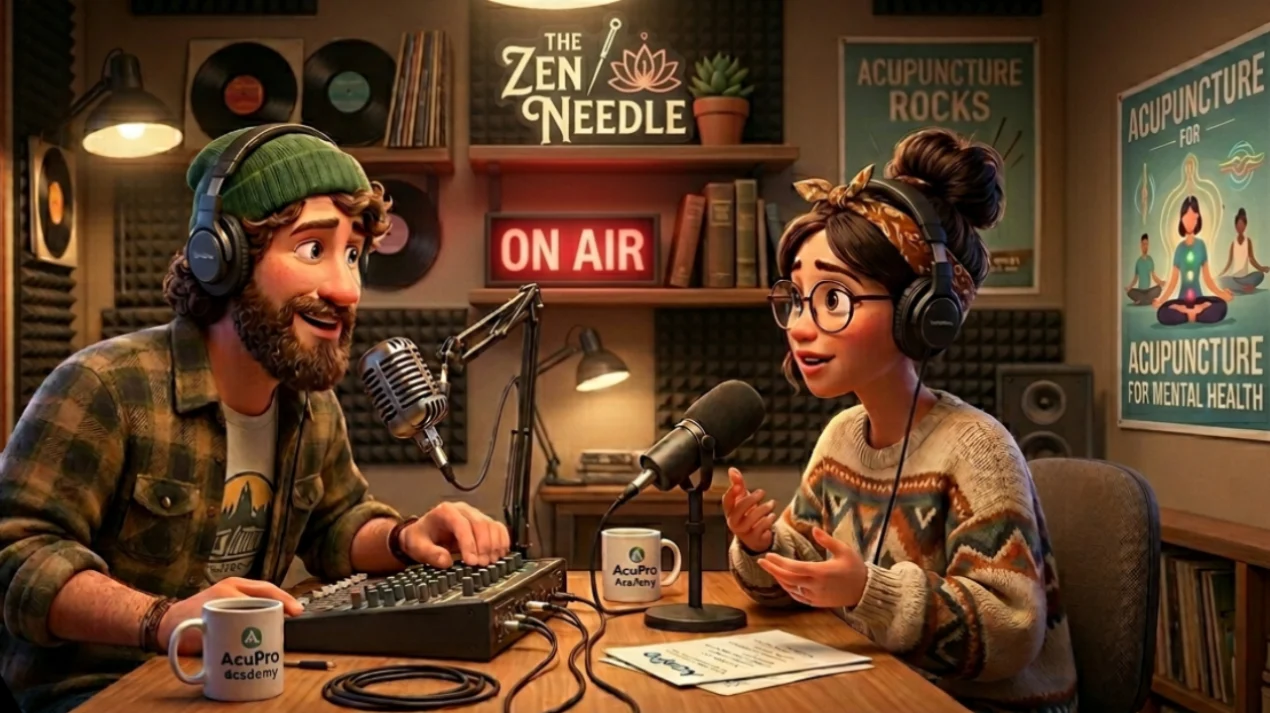
I took one of my most popular YouTube videos on acupuncture points for mental health and had it transformed into a conversation using AI tools like NotebookLM.
The goal?
To explore how TCM concepts sound when viewed from the outside: through a more conversational, simplified, and relatable lens.
Because let’s be honest… sometimes TCM can feel complex. And if we can make it easier to understand, for both practitioners and patients, that’s a win.
The Deep Connection Between Mind and Body
Let’s start with something fundamental:
In TCM, the mind and body are not separate.
They are one system.
So when we talk about mental health: whether it’s anxiety, insomnia, or depression, we’re not just looking at the brain. We’re looking at the entire body.
Think about it:
- Chronic stress affecting digestion
- Anxiety tightening the chest
- Emotional overwhelm leading to fatigue
These aren’t coincidences. They’re connections.
In fact, TCM teaches that many chronic conditions are deeply rooted in unprocessed or unexpressed emotions.
How Trauma Lives in the Body
Have you ever felt stress in your shoulders? Or a knot in your stomach before something important?
That’s your body talking.
From a TCM perspective:
- The Liver is associated with stress, frustration, and anger
- The Spleen is linked to worry and overthinking
- The Lungs relate to grief and sadness
So when emotions aren’t processed, they don’t just disappear…
They get stored.
And over time, that can lead to physical symptoms.
How Acupuncture Supports Mental Health
Now here’s where acupuncture comes in, and why it’s so powerful.
A tiny needle, inserted just millimeters into the skin, can shift the body from a fight-or-flight state into a rest-and-digest state.
From a biomedical perspective, acupuncture:
- Stimulates nerve endings
- Activates mechanoreceptors in connective tissue
- Triggers the release of endorphins and neurotransmitters
This helps regulate the nervous system and promotes a sense of calm.
From a TCM perspective?
We’re moving Qi, regulating organs, and restoring balance.
Different language… same goal.
The Pathways That Connect Everything
One of the most fascinating bridges between Eastern and Western understanding is the concept of pathways.
In TCM, we call them meridians.
Modern research suggests these pathways may align with connective tissue networks rich in sensory receptors.
So when we stimulate an acupuncture point:
- We’re influencing local tissue
- Sending signals through the nervous system
- Creating systemic effects throughout the body
It’s not magic.
It’s physiology.
Recognizing Emotional Patterns in the Body
Here’s something I always tell my students and patients:
👉 Pay attention to where you feel things.
Because your body gives you clues.
- Tight shoulders → stress, tension (Liver)
- Heavy chest → anxiety, grief (Lung/Heart)
- Digestive discomfort → worry, overthinking (Spleen)
When you start noticing these patterns, you can begin to treat proactively instead of reactively.
Using Technology to Enhance Learning
Now let’s talk about the “experiment” part of this episode.
Using tools like NotebookLM, I was able to turn a structured teaching video into a dynamic, conversational format.
And honestly?
It opens up a really interesting door.
Because as practitioners and students, we’re often dealing with:
- Long lectures
- Complex theory
- Dense material
AI tools can help simplify, summarize, and reinforce learning in a way that feels more accessible.
It’s not about replacing traditional learning, it’s about enhancing it.
A New Frontier for TCM Education
Does using AI to learn Chinese medicine feel a little strange?
Maybe.
But it’s also exciting.
Because it means:
- More people can access this knowledge
- Students can learn faster and more efficiently
- Practitioners can revisit concepts in new ways
And ultimately, that helps us become better at what we do.
Final Thoughts
This episode was definitely a little outside the box, but that’s how we grow, right?
Whether it’s exploring the connection between emotions and the body, or experimenting with new ways to learn, the goal stays the same:
👉 To better understand, support, and treat our patients.
So I’d love to hear from you:
- Did you enjoy this format?
- Did it help you see TCM differently?
And as always…
Keep learning.
Keep healing.
And keep rocking it with TCM 💜
Disclaimer
The AcuPro Show podcast and material shared through AcuPro Academy is a subdivision of Natural Health Sense Incorporated. Designed solely for educational and entertainment purposes. The utilization of information from this podcast or any associated material is at the user’s discretion and risk. This content is not meant to replace the guidance of an acupuncturist. Nor Chinese medicine doctor, medical doctor, physician, or any qualified professional. It is not a substitute for proper diagnosis or treatment. Users are strongly advised not to ignore or postpone seeking medical advice for any existing medical condition with their healthcare professional. Regarding any health concerns.
Share this article

Written by : AcuPro Academy (Clara)
Related Posts




Latest articles

October 23, 2026
October 23, 2026
October 23, 2026