
Top 5 Spleen Acupuncture Points YOU Need to Use in Practice!
The Spleen channel has 21 acupuncture points, and every single one has its place in clinical practice. But if I had to choose five Spleen acupuncture points that I think are particularly powerful and versatile, these are the ones I wouldn’t want to practice without.
These points can help address everything from digestive problems and dampness to menstrual cramps, reproductive health, chronic muscle pain, stress, and anxiety.
And stay until the end, because I’m also sharing one of my favorite acupuncture point combinations for both physical and mental fatigue, even when you’re not completely sure of your TCM diagnosis yet.
Let’s do this!
Clara
TCM Geek
Links mentioned in this video:
💌 Sign up to my FREE newsletter here!
📙 Get your copy of AcuPoints Made Easy Book or PDF!
5 Powerful Spleen Acupuncture Points Every Practitioner Should Know
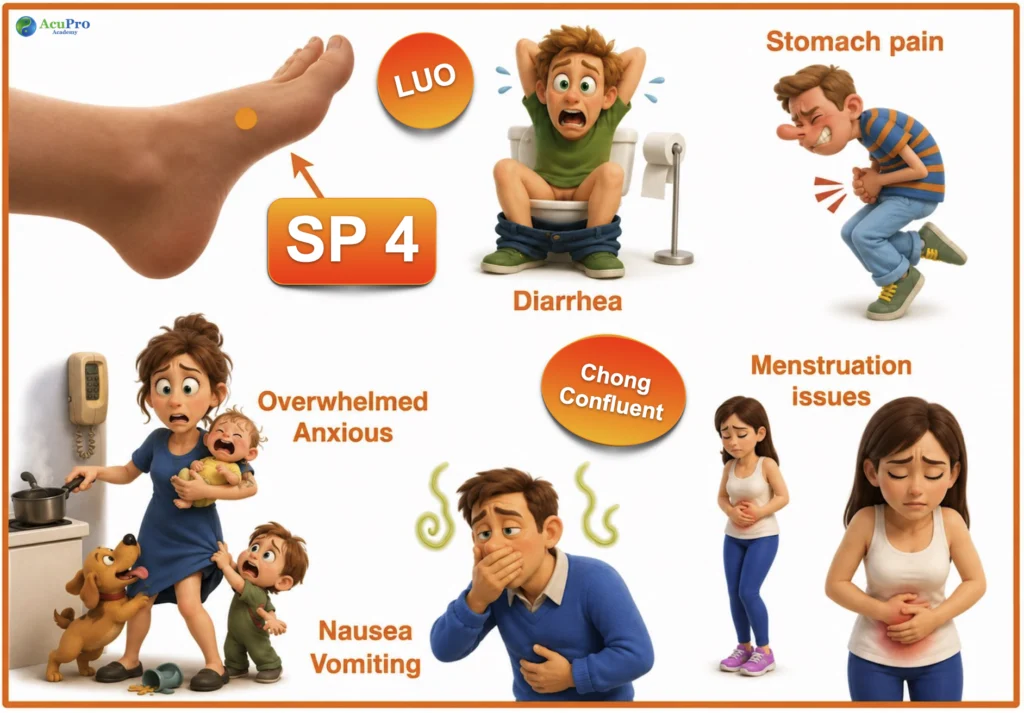
Spleen 4: The Luo-Connecting and Chong Vessel Point
My first choice is Spleen 4, and I absolutely love this point.
Spleen 4 is located distally and inferiorly to the base of the first metatarsal bone, at the junction between the sole and the top of the foot.
One of the reasons this point is so powerful is because it is the Luo-Connecting point of the Spleen channel, connecting the Spleen and Stomach systems. Because of this relationship, Spleen 4 is an excellent point for regulating the digestive system as a whole.
Think about the difference between the Spleen and Stomach in TCM. The Stomach is responsible for receiving and descending food and fluids, while the Spleen is responsible for transforming and transporting nutrients. When these functions become disrupted, we can see symptoms such as nausea, vomiting, loose stools, diarrhea, bloating, and abdominal discomfort.
Spleen 4 can be particularly useful when working with digestive symptoms, and I also love it for abdominal pain related to emotional eating or emotional overeating. In that situation, you could consider combining it with Spleen 1.
A Powerful Damp-Heat Combination
One of my favorite clinical combinations is to pair the two Luo-Connecting points:
Spleen 4 + Stomach 40
Together, these points can help address the Spleen and Stomach digestive systems, particularly when there are signs of Damp-Heat in the Middle Jiao.
You might see a combination of symptoms such as:
- Acid reflux or heartburn
- Stomach pain
- Increased hunger
- Abdominal bloating
- Loose or smelly diarrhea
- Damp-Heat signs affecting digestion
To create a more comprehensive Damp-Heat treatment, you could add Spleen 9 and Large Intestine 11. This gives you a powerful combination for clearing Damp-Heat from the Middle Jiao while supporting the digestive system.
Spleen 4 and the Chong Vessel
Spleen 4 is also the Confluent point of the Chong Mai, or Chong Vessel, which makes it especially interesting when working with women’s health and blood-related patterns.
The Chong Vessel is often referred to as the Sea of Blood, so Spleen 4 can be useful when addressing menstrual irregularities, menstrual pain, or issues related to blood deficiency.
Because the Spleen is responsible for producing Blood from the nutrients we obtain from food, Spleen 4 can be particularly relevant when there are signs of Blood deficiency affecting menstruation.
It may also be considered when there is a lack of breast milk related to Blood deficiency, as breast milk is traditionally understood in TCM to have a relationship with Blood.
For reproductive system concerns involving Blood deficiency or Blood stasis, another combination to consider is:
Spleen 4 + Pericardium 6
And because Spleen 4 can also be helpful when emotional overwhelm leads to anxiety and excessive thinking, you could combine it with Spleen 5 for patients who are overwhelmed, worried, and mentally exhausted. Adding Liver 3 can further help address stress and Liver Qi stagnation.
That’s a lot of clinical applications for one little point!
Spleen 6: The Three Yin Crossing Point
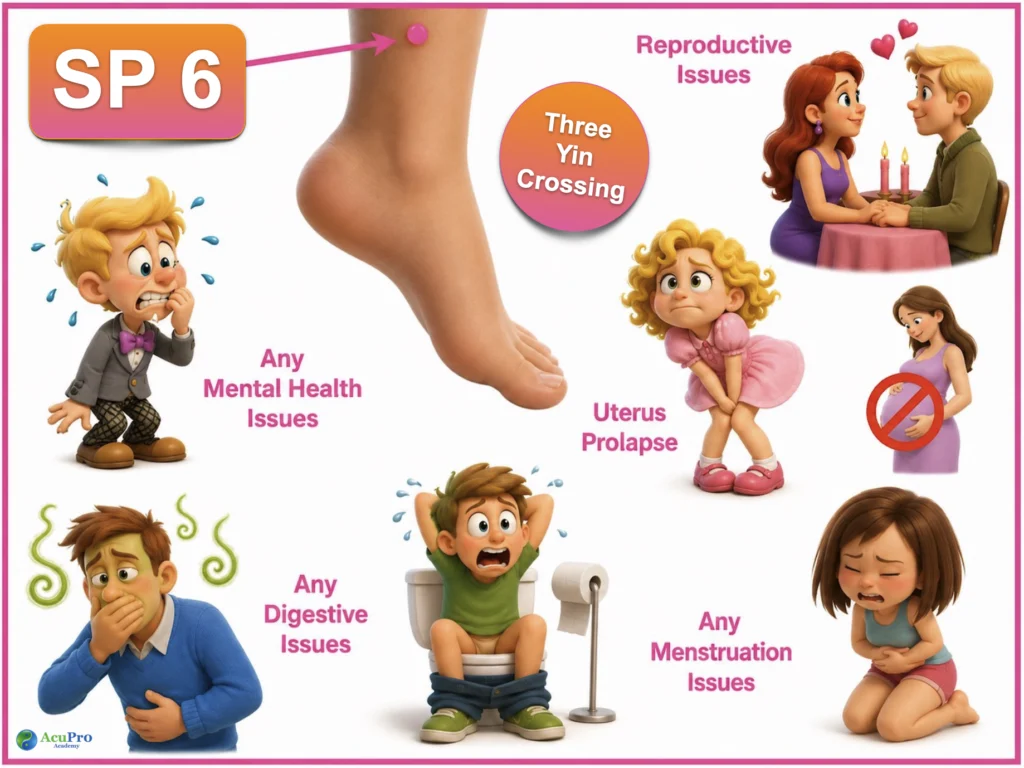
My second choice is Spleen 6, which is one of my absolute favorite points. Spleen 6 is located three cun above the medial malleolus, on the line between Spleen 9 and the medial malleolus, posterior to the medial border of the tibia.
Its name, San Yin Jiao, means “Three Yin Crossing,” because the point is where the Spleen, Liver, and Kidney channels intersect. This makes Spleen 6 incredibly versatile. Because it connects these three channels, it can be incorporated into treatments involving patterns affecting the Spleen, Liver, or Kidney.
Spleen 6 for Women’s Health
Spleen 6 is a classic point for many reproductive and gynecological concerns, including:
- Fertility
- Menstruation
- Amenorrhea
- Dysmenorrhea
- Menopause
- Reproductive health
It can also be used when Spleen Qi sinking contributes to organ prolapse.
For example, when working with prolapse of the uterus, bladder, or rectum, you might consider a combination of:
Spleen 6 + Ren 6 + Du 20
The idea is to support the Spleen’s function of raising and holding Qi while helping to lift sinking Qi.
Spleen 6 for Digestion and IBS
Spleen 6 is also a wonderful point for digestive issues such as constipation, diarrhea, IBS, and nausea.
IBS is particularly interesting from a TCM perspective because it can involve the relationship between the Liver and Spleen. Stress and emotional tension may affect the Liver, while the resulting digestive symptoms involve the Spleen.
This makes Spleen 6 a useful point to consider when treating the whole picture. Spleen 6 can also help calm the mind and may be incorporated into treatments for worry, overthinking, anxiety, fear, and phobias.
For fear and phobias, you might consider combining it with Kidney 4. For excessive thinking and worrying that leads to mental or physical fatigue, Spleen 5 can be a great addition.
Spleen 6 also nourishes Yin and Blood, making it a valuable point when deficiency of either is part of the patient’s pattern. And there’s another application that I think doesn’t always get enough attention: the hips and pelvic floor.
The Spleen channel travels through the hip girdle, so Spleen 6 can be an excellent point to consider for hip and pelvic floor issues.
One very important reminder, though: Spleen 6 is contraindicated during pregnancy.
Spleen 9: The Dampness-Draining Powerhouse
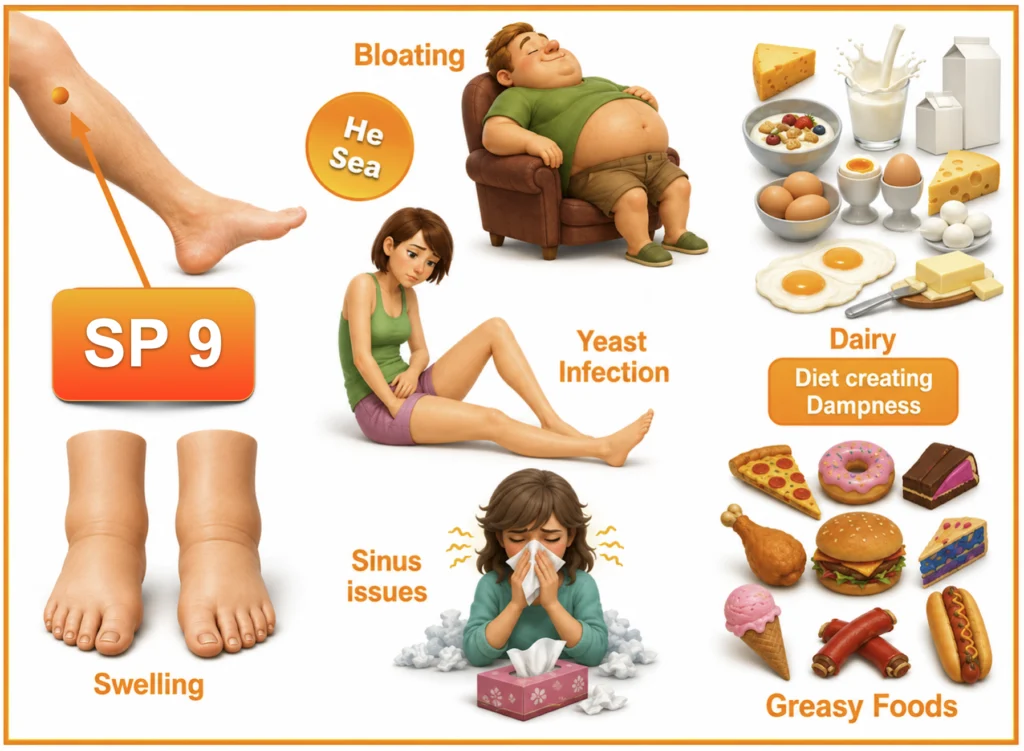
My third choice is Spleen 9, located below and posterior to the border of the medial condyle of the tibia.
If you’re thinking about Dampness, Spleen 9 should immediately come to mind.
Spleen 9 is the He-Sea point of the Spleen channel, and it is one of the points I think of first when I need to eliminate Dampness.
Dampness can manifest in many different ways throughout the body, so Spleen 9 has an incredibly broad range of applications.
You might consider it for:
- Diarrhea
- Bloating
- Abnormal vaginal discharge
- Nasal discharge
- Postnasal drip
- Urinary incontinence
- Edema
For postnasal drip or nasal discharge, you could consider combining Spleen 9 with Large Intestine 20.
The main clinical pearl I want you to remember is simple:
Whenever you’re trying to eliminate Dampness, think Spleen 9.
Spleen 8: The Xi-Cleft Point for Menstrual Cramps
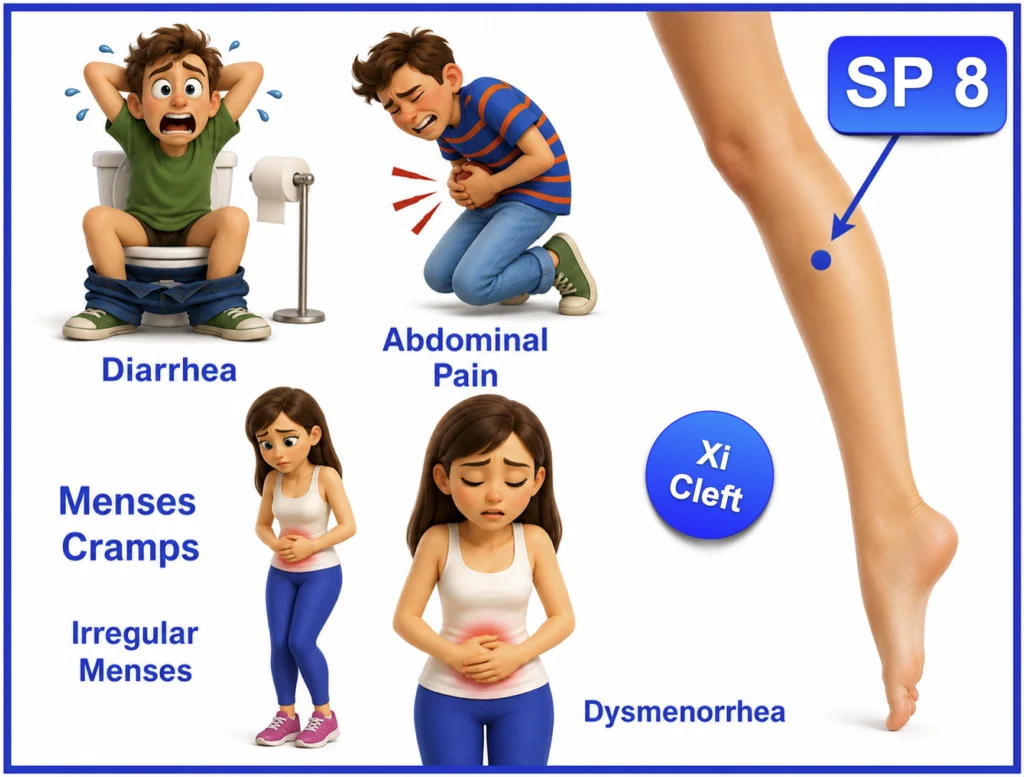
My fourth choice is Spleen 8, located three cun below Spleen 9, on the line between Spleen 9 and the medial malleolus.
Spleen 8 is the Xi-Cleft point of the Spleen channel, which makes it particularly valuable when you’re working with acute conditions involving Blood and pain.
One of my favorite clinical uses for Spleen 8 is menstrual cramps and dysmenorrhea.
If a patient is sitting in front of you with menstrual cramps right now, this is a point I would absolutely consider.
Even better, you can combine Spleen 8 with the Xi-Cleft points of the Liver and Kidney channels:
Spleen 8 + Liver 6 + Kidney 5
This combination brings together the three Xi-Cleft points of the Spleen, Liver, and Kidney channels and can be particularly useful for acute menstrual pain.
Spleen 8 can also be used for digestive symptoms such as diarrhea, abdominal pain, and loose stools, but personally, I tend to remember it first for its powerful application in menstrual cramps.
When you’re thinking about acute pain related to menstruation, Spleen 8 deserves a place in your toolkit.
Spleen 21: The Major Luo-Connecting Point
My fifth choice is Spleen 21, the final point on the Spleen channel.
Spleen 21 is located on the mid-axillary line in the sixth or seventh intercostal space, depending on the individual. This is a point that should be located through palpation, as tenderness can help guide you to the appropriate location.
Spleen 21 is particularly special because it is the Major Luo-Connecting point of the Spleen.
While Spleen 4 is the regular Luo-Connecting point of the Spleen channel, Spleen 21 has a broader relationship with the muscular regions of the body.
In TCM, we often associate the Liver with the tendons, ligaments, and joints, while the Spleen is associated with the muscles.
This makes Spleen 21 a fascinating point to consider when working with chronic muscle pain and widespread muscular conditions.
I particularly like it for fibromyalgia and chronic muscle pain. It can also be considered for rheumatoid arthritis, and you might combine it with Gallbladder 34 depending on the presentation.
It’s a point that I think deserves much more attention in clinical practice.

Bonus Point: Spleen 3
I know what some of you might be thinking.
“What about Spleen 10?”
Or perhaps you’re wondering why I haven’t mentioned Spleen 5, which is such a fantastic point for overthinking.
Well, I wanted to give you a bonus point, and my choice is Spleen 3.
Spleen 3 is the Yuan-Source point of the Spleen, and I think it is often underused in clinical practice.
If your patient presents with a classic picture of Spleen Qi deficiency, particularly when the digestive system is affected, Spleen 3 deserves your attention.
Think about a patient with:
- Poor appetite
- Fatigue
- Bloating
- Loose stools
- Weak digestion
The Spleen’s fundamental role is to transform and transport nutrients, and Spleen 3 can be a wonderful point to consider when this function is compromised.
So don’t forget about Spleen 3!
My Favorite Acupuncture Point Combination for Fatigue
At the beginning, I promised you a combination for fatigue, and here it is.
When someone is experiencing fatigue, we know that we ultimately need to understand the underlying TCM pattern. Is it Qi deficiency? Blood deficiency? Yang deficiency? Something else?
A complete diagnosis is always important.
But if you’re looking for a starting point, I love this combination:
Spleen 6 + Ren 6 + Du 20 + Stomach 36
This combination brings together points that can help support Qi and Blood while also helping to lift and raise energy.
If the fatigue is primarily mental fatigue, especially when there is a lot of overthinking and worrying, I would consider adding:
Spleen 5
This is where we start to see the beauty of point selection in TCM. You aren’t simply choosing points based on a symptom. You’re looking at the person, identifying the underlying pattern, and then building a treatment that addresses the whole picture.
Final Thoughts
The Spleen channel has 21 acupuncture points, and there are so many incredible points to explore. These five (or six, if we count our bonus point)are simply the ones I find particularly powerful and versatile in clinical practice.
If I had to summarize the key points from today’s discussion, I’d remember them like this:
- Spleen 4: Digestive regulation, Chong Vessel, Blood, reproductive health, emotional overwhelm
- Spleen 6: Three Yin Crossing, women’s health, digestion, Yin and Blood, anxiety, hips and pelvic floor
- Spleen 9: Dampness, Dampness, and more Dampness!
- Spleen 8: Xi-Cleft point, acute menstrual cramps and dysmenorrhea
- Spleen 21: Major Luo-Connecting point, chronic muscle pain and muscular conditions
- Spleen 3: Yuan-Source point and a valuable choice for Spleen Qi deficiency
The more you understand the functions and relationships of each acupuncture point, the easier it becomes to select points with confidence.
And remember, the best treatment isn’t necessarily the one with the most points. It’s the one where every point has a purpose.
I hope this gave you a few new clinical pearls to take into your practice. Keep exploring the channels, keep connecting the dots, and as always, keep rocking it using TCM!
Share this article