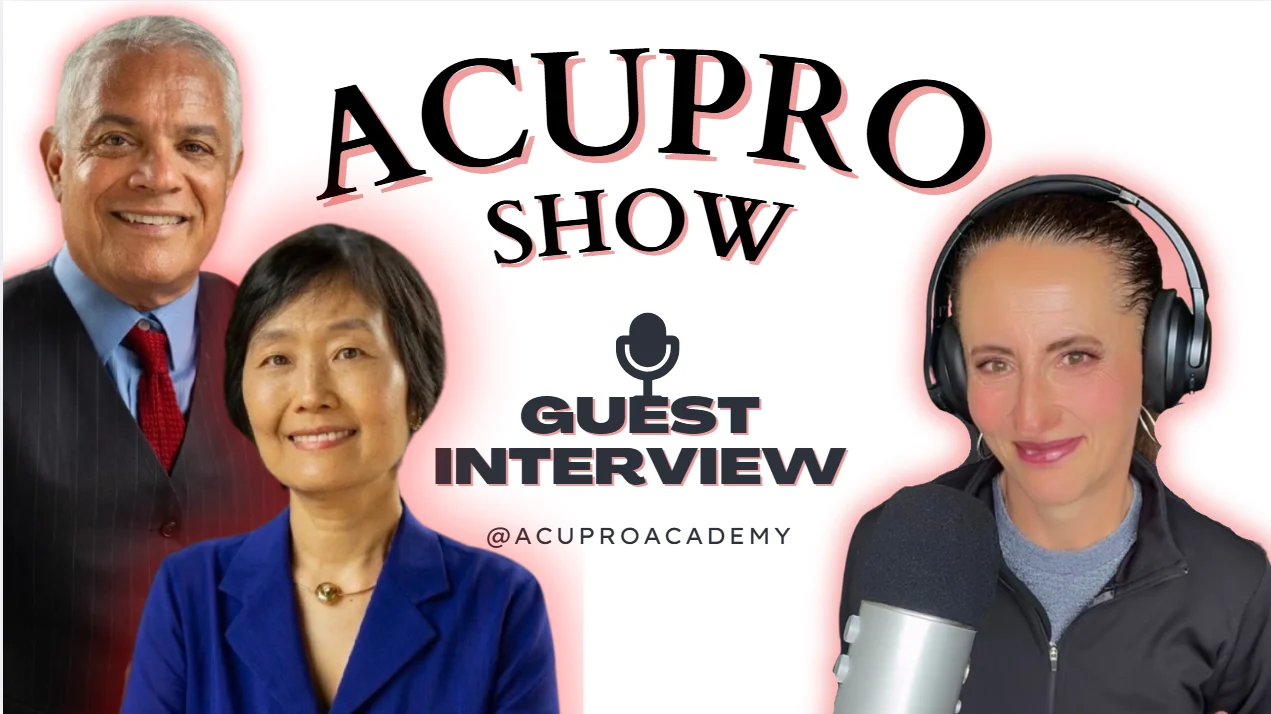
#151 – Tai Chi Walking for Longevity with Dr. Jacques MoraMarco & Dr. Yun Kim (Podcast)
Listen on Apple Podcasts Listen on Spotify Listen on YouTube Listen on Amazon Music
🔗 Links mentioned in this episode:
🤓 Learn with Quick 90-minute Masterclasses & Get CEUs!
📙 Get your copy of Walking Your Way to Vitality by Dr. Yun Kim & Jacques MoraMarco!
🩵 Curious if Jane is right for your practice? Book a free demo and get a one-month grace period with code ACUPRO1MO!
☯️ More AcuPro Episodes you’ll love:
The Power of Qi Gong with Britta Stalling
TCM Longevity Secrets with Dr. Mao Shing Ni
How Dysregulation Affects Our Mental & Physical Health with Kristi McLeod
Embracing Tai Chi and Qigong: A Conversation with Dr. Jacques MoraMarco and Dr. Yun Kim
When we talk about Chinese medicine, acupuncture, herbs, and nutrition often take center stage. But there are other powerful practices within the broader Chinese medicine tradition that deserve just as much attention.
Tai Chi and Qigong are two beautiful examples.
In this episode of the AcuPro Show, I had the pleasure of speaking with Dr. Jacques MoraMarco and Dr. Yun Kim about their experiences with Tai Chi and Qigong, the role movement can play in supporting vitality, and how these practices can become simple and accessible parts of our everyday lives.
Both Dr. Yun and Dr. Jacques have dedicated years to Chinese medicine and movement practices, and their passion for Tai Chi and Qigong really shines through in our conversation.
The Often-Overlooked Power of Tai Chi
As practitioners of Chinese medicine, we spend a lot of time talking about acupuncture points, herbal medicine, nutrition, and diagnosis. Yet movement practices can also play an important role in maintaining health and vitality.
Tai Chi is sometimes thought of primarily as a martial art, but it can also be approached as a gentle movement practice that encourages awareness, coordination, breathing, and presence.
During our conversation, Dr. Jacques and Dr. Yun shared their experiences with Tai Chi and discussed why they believe these practices deserve more attention.
One of the things I particularly appreciated was their emphasis on making movement accessible. You don’t necessarily need a complicated routine or hours of free time to begin. Even small, consistent practices can become meaningful additions to a person’s daily routine.
Getting to Know Dr. Yun Kim
Dr. Yun Kim shared her personal connection to Chinese medicine, including growing up in a family of acupuncturists and continuing her professional development at Emperor’s College.
Her experience as both a Chinese medicine practitioner and a Tai Chi practitioner gives her a unique perspective on the importance of movement and self-care.
Dr. Yun also co-authored Walking Your Way to Vitality with Dr. Jacques. The book focuses on incorporating simple movement and walking practices into everyday life.
Throughout our conversation, Dr. Yun highlighted the importance of practitioners taking care of themselves so they can continue to be fully present for the people they serve.
Dr. Jacques MoraMarco’s Journey with Tai Chi
Dr. Jacques MoraMarco has a fascinating background in martial arts and Tai Chi.
His journey has included studying with influential teachers and traveling to China to study Sun style Tai Chi. His dedication to the practice reflects many years of learning, refinement, and personal experience.
What stood out to me was how Tai Chi became much more than simply a series of movements. For Dr. Jacques, it has been a lifelong practice that continues to evolve.
What Is the Difference Between Tai Chi and Qigong?
One of the questions I wanted to explore during our conversation was the difference between Tai Chi and Qigong.
These two practices are often mentioned together, and it can be confusing to understand how they differ.
Dr. Jacques described Tai Chi as being more focused on forms and movements, while Qigong places greater emphasis on breathwork and working with the body’s energy.
There is certainly overlap between the two, but each practice has its own characteristics and approaches.
Rather than thinking of them as competing practices, they can be viewed as complementary tools that people can explore according to their interests and needs.
Making Movement Part of Your Daily Routine
One of my favorite parts of the conversation was discussing how to make these practices realistic for everyday life.
Dr. Jacques and Dr. Yun’s book, Walking Your Way to Vitality, includes a seven-week program built around accessible walking practices.
The idea is refreshingly simple: movement doesn’t have to be complicated.
You can start small.
Even five minutes of intentional movement can be a starting point for creating a consistent habit. From there, the practice can gradually become part of your daily routine.
Consistency is key.
Rather than waiting for the perfect schedule or setting aside a huge amount of time, finding small opportunities to move throughout the day can make these practices much more approachable.
Self-Care for Chinese Medicine Practitioners
As practitioners, we spend so much of our time caring for other people that it can be easy to forget about our own energy and wellbeing.
Dr. Yun shared that she sometimes practices Tai Chi during her lunch break. That small window of time gives her an opportunity to step away, move her body, reconnect with herself, and return to her work feeling rejuvenated.
Dr. Jacques also emphasized finding practices that genuinely resonate with you. For one person, that might be Tai Chi. For another, it might be meditation, affirmations, walking, or another form of mindful movement.
The important thing is finding something that helps you reconnect and maintain your own sense of balance.
Chinese Medicine Is More Than Points and Needles
Another important theme that came through in our conversation was the deeper philosophy behind practicing Chinese medicine.
Chinese medicine isn’t simply about selecting the right acupuncture points or finding the perfect treatment protocol.
There is also an important human element to the therapeutic relationship.
Dr. Yun spoke about approaching treatments with intention and an open heart. As practitioners, we have the opportunity to create a space where patients feel seen, supported, and connected.
This is an aspect of practice that can sometimes be overlooked when we become focused on diagnosis, treatment strategies, and technical skills.
Our knowledge matters, but so does the way we show up for our patients.
Preventative Care and Investing in Your Health
We also touched on the importance of preventative care and making health a priority before problems arise.
Dr. Yun shared wisdom from the Huangdi Neijing, often translated as the Yellow Emperor’s Classic of Internal Medicine, regarding the importance of cultivating health and preventing illness.
This idea fits beautifully with the concept of incorporating simple, sustainable practices into everyday life.
You don’t have to wait until you’re struggling with your health to begin paying attention to your body.
Walking, mindful movement, Tai Chi, Qigong, meditation, and other practices can all provide opportunities to develop greater awareness and make health a regular part of your daily life.
Health, Vitality, and “Eternal Spring”
Dr. Jacques shared a beautiful Tai Chi saying about seeking “health and vitality and eternal spring.”
I love the sentiment behind this idea.
It reminds us that cultivating vitality doesn’t have to be about chasing youth. Instead, it can be about continuing to move, learn, connect, and care for ourselves throughout every stage of life.
Tai Chi and Qigong offer practices that can be adapted and explored over time, making them interesting tools for people at many different points in their lives.
Final Thoughts
This conversation with Dr. Jacques MoraMarco and Dr. Yun Kim was such a wonderful reminder that Chinese medicine extends far beyond acupuncture needles and herbal formulas.
Movement, breath, intention, self-awareness, and preventative care can all have a place in our approach to health.
And perhaps the most important takeaway is that getting started doesn’t have to be complicated.
Take a walk.
Spend a few minutes moving your body.
Try Tai Chi or Qigong.
Step outside and breathe.
Find something that helps you reconnect with yourself.
Small practices, when repeated consistently, can become meaningful parts of our lives.
Thanks for joining me for this conversation, and as always, keep rocking it with TCM!
Disclaimer
The AcuPro Show podcast and material shared through AcuPro Academy, which is a subdivision of Natural Health Sense Incorporated. Designed solely for educational and entertainment purposes. The utilization of information from this podcast or any associated material is at the user’s discretion and risk. This content is not meant to replace the guidance of an acupuncturist. Nor a Chinese medicine doctor, medical doctor, physician, or any qualified professional. It is not a substitute for proper diagnosis or treatment. Users are strongly advised not to ignore or postpone seeking medical advice for any existing medical condition with their healthcare professional, regarding any health concerns.
Need the podcast transcript? Click here!
Share this article

Written by : AcuPro Academy (Clara)
Related Posts




Latest articles
November 25, 2026

November 25, 2026