
Top 5 Liver Channel Acupuncture Points You Must Use in Practice!
The Liver channel is one of the most important channels to understand in clinical practice. With 14 acupuncture points to choose from, there are plenty of powerful tools available to us. However, there are five Liver points that I find myself returning to again and again.
In this video, we’re exploring five of my favourite acupuncture points on the Liver channel. Each one has a unique role to play, from calming Liver Yang Rising and moving Liver Qi to clearing Damp-Heat and addressing digestive discomfort.
And stick around until the end, because I’ll also share one of my favourite acupuncture point combinations to consider when working with interstitial cystitis.
Let’s do this!
Clara
TCM Geek
Links mentioned in this video:
🎓 How to Select Acupoints Masterclass
💌 Sign up to my FREE newsletter here!
📙 Get your copy of AcuPoints Made Easy Book or PDF!
🩵 Curious if Jane is right for your practice? Book a free demo and get a one-month grace period with code ACUPRO1MO!
Top 5 Liver Channel Acupuncture Points You Must Use in Practice
Liver 2: Bringing Calm to the Storm
Let’s start with Liver 2, a point I love for situations where the Liver is becoming a little too heated.
Located on the foot, at the web margin between the first and second toes. Liver 2 is the Ying-Spring and Fire point of the Liver channel. Clinically, it’s particularly useful for draining Liver Fire and calming Liver Yang Rising.
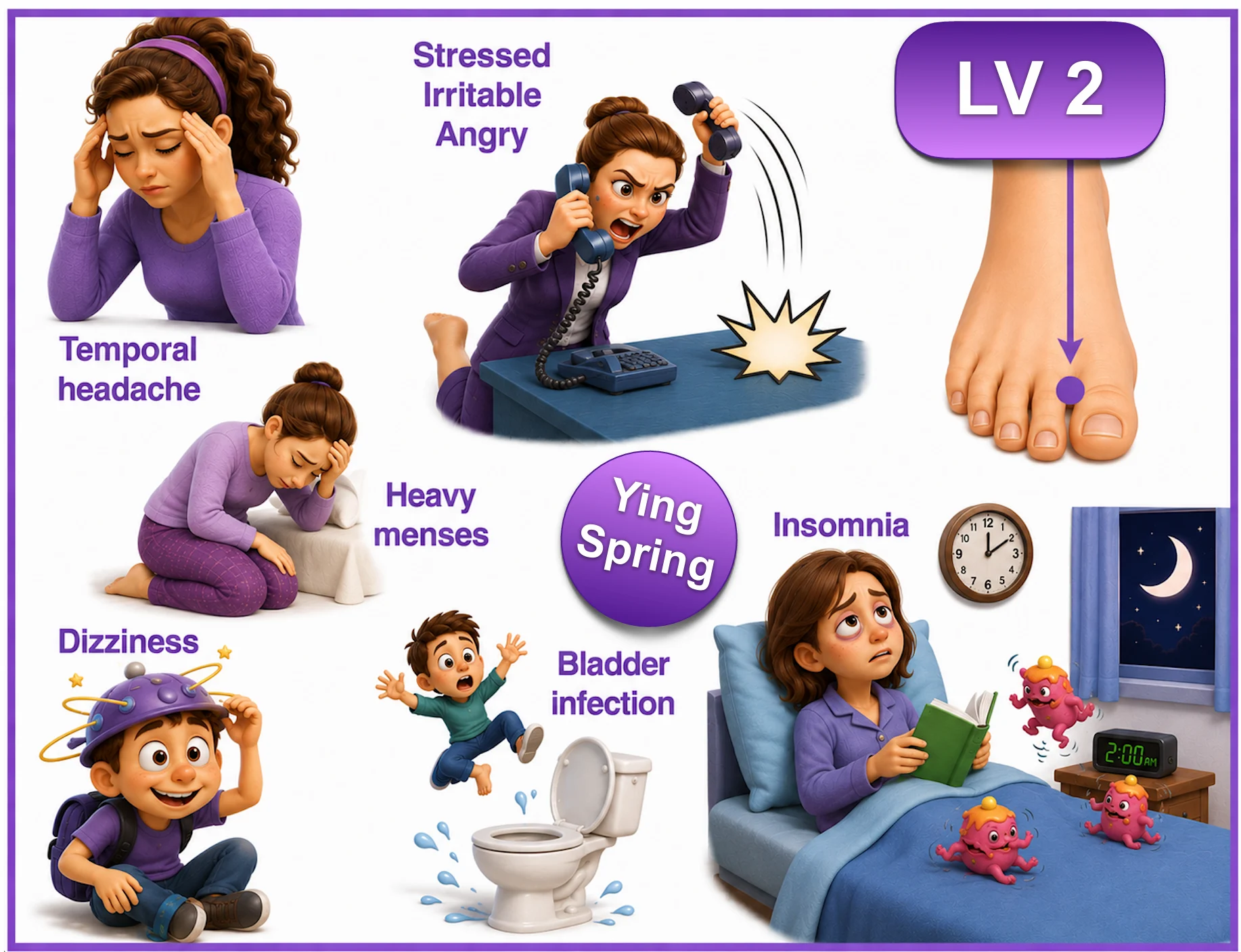
This makes it a fantastic point to consider when a patient presents with symptoms associated with excess heat, stress, and overwhelm. Think about symptoms such as anger, irritability, insomnia, temporal headaches, red eyes, and constipation caused by excess heat.
Liver 2 can also be useful when working with high blood pressure. It may help address heavy or flooding menstrual bleeding, particularly during perimenopause.
As always, the key is proper TCM diagnosis. Not every headache, sleep problem, or menstrual issue is a Liver 2 presentation. We want to understand the underlying pattern and make sure we’re treating the root and branch appropriately.
Liver 3: The Flow Master
It would be impossible to talk about powerful Liver channel points without mentioning Liver 3.
This is one of the most frequently used acupuncture points in clinical practice, and for good reason. Located on the dorsum of the foot, distal to the junction of the first and second metatarsal bones. Liver 3 is the Yuan-Source point of the Liver channel and one of our go-to points for moving Liver Qi.
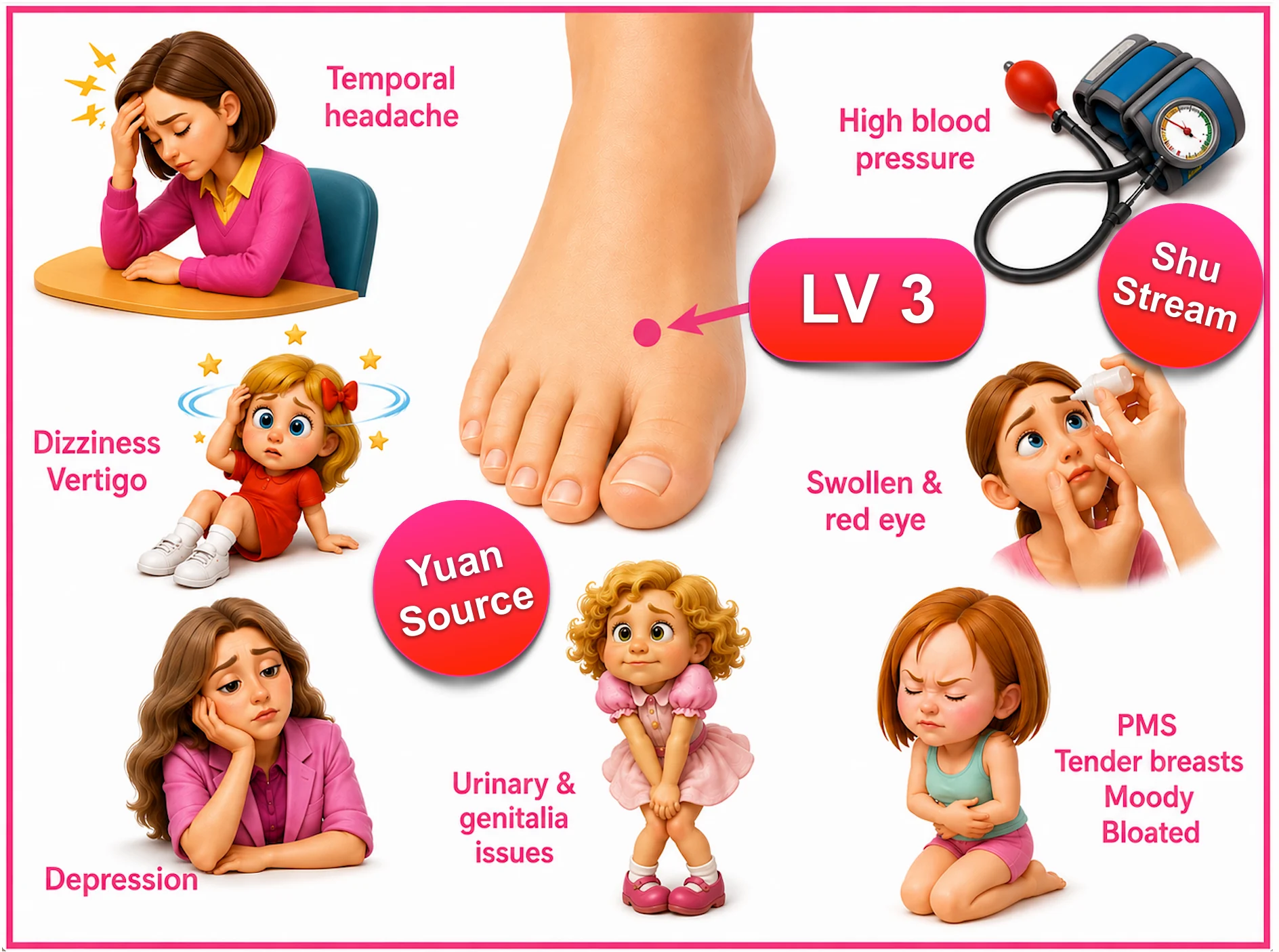
And let’s be honest: Liver Qi stagnation is something we see all the time.
When Qi isn’t flowing smoothly, patients may experience mood swings, PMS, irritability, depression, tension, and headaches. Liver 3 is an incredibly versatile point for helping restore that sense of movement and flow.
One of my favorite combinations is Liver 3 with Large Intestine 4, commonly known as the Four Gates. Together, these two points are traditionally used to move Qi and Blood throughout the body. This makes them a powerful combination when there is stagnation.
When I think about Liver 3, I think about movement. When things feel stuck physically, emotionally, or energetically, this is a point that deserves consideration.
Liver 5: The Unsung Hero
Next up is Liver 5, a point that I think deserves much more attention.
Liver 5 is located five cun above the medial malleolus, on the medial aspect of the tibia. It is the Luo-Connecting point of the Liver channel, and clinically, it can be an incredibly useful point when working with Damp-Heat.
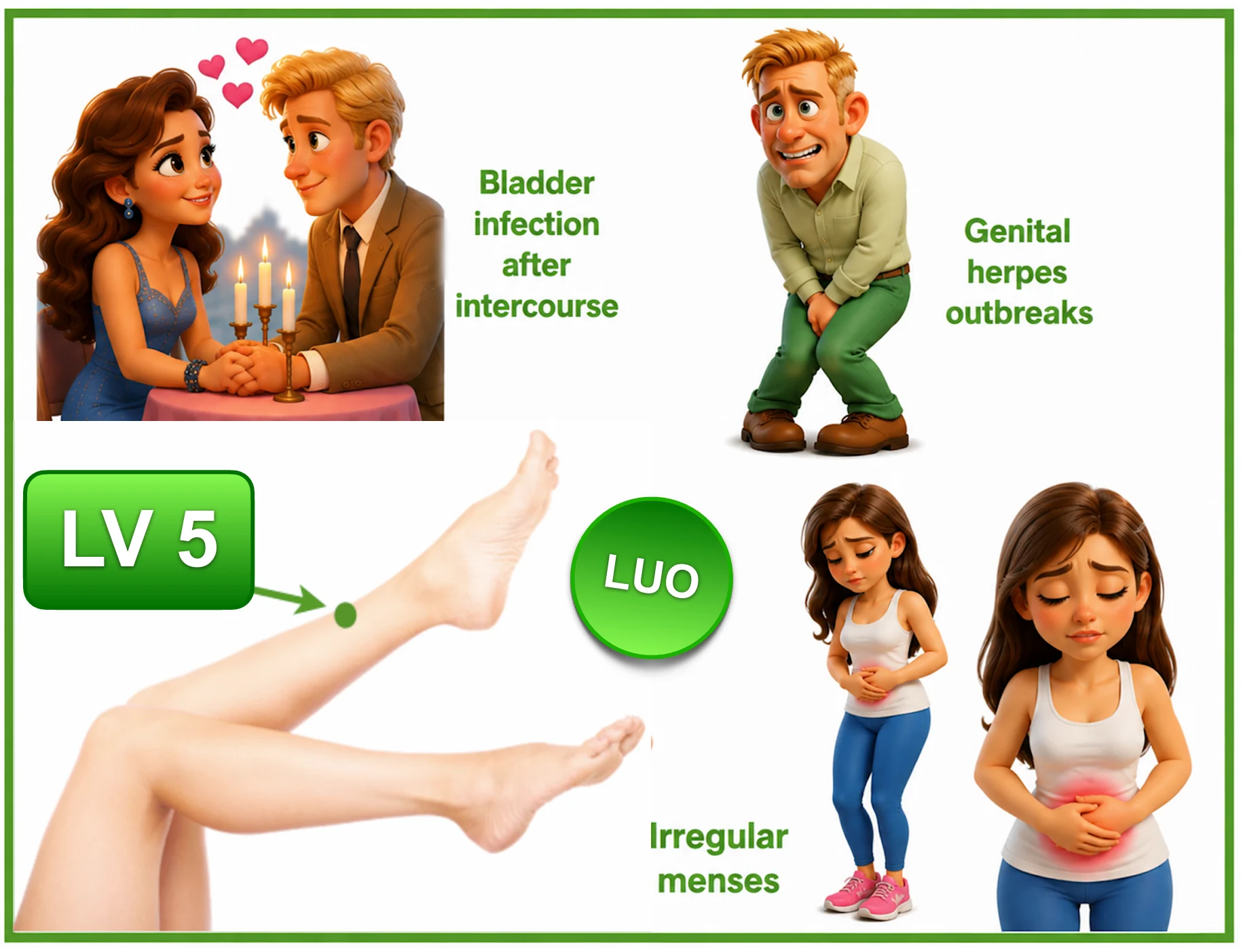
One of the areas where I find this point particularly interesting is in conditions affecting the external genital region. Liver 5 can be considered when Damp-Heat manifests with issues such as genital itching or outbreaks, including presentations involving yeast infections or herpes.
It’s also a point I like to keep in mind when working with bladder infections that occur after intercourse.
Of course, these types of symptoms always require careful assessment and appropriate medical evaluation when necessary. But from a TCM perspective, Liver 5 can be a valuable point to consider when Damp-Heat is involved.
This is one of those points that may not be the first one that comes to mind for every practitioner, but once you start using it clinically, you’ll understand why I call it an unsung hero.
Liver 13: The Zang Influential Point
Moving up the Liver channel, we come to Liver 13.
Located below the free end of the 11th rib, Liver 13 is the Influential Point of the Zang organs. This gives it a broader role in treatment and makes it a particularly interesting point when digestive and abdominal symptoms are present.
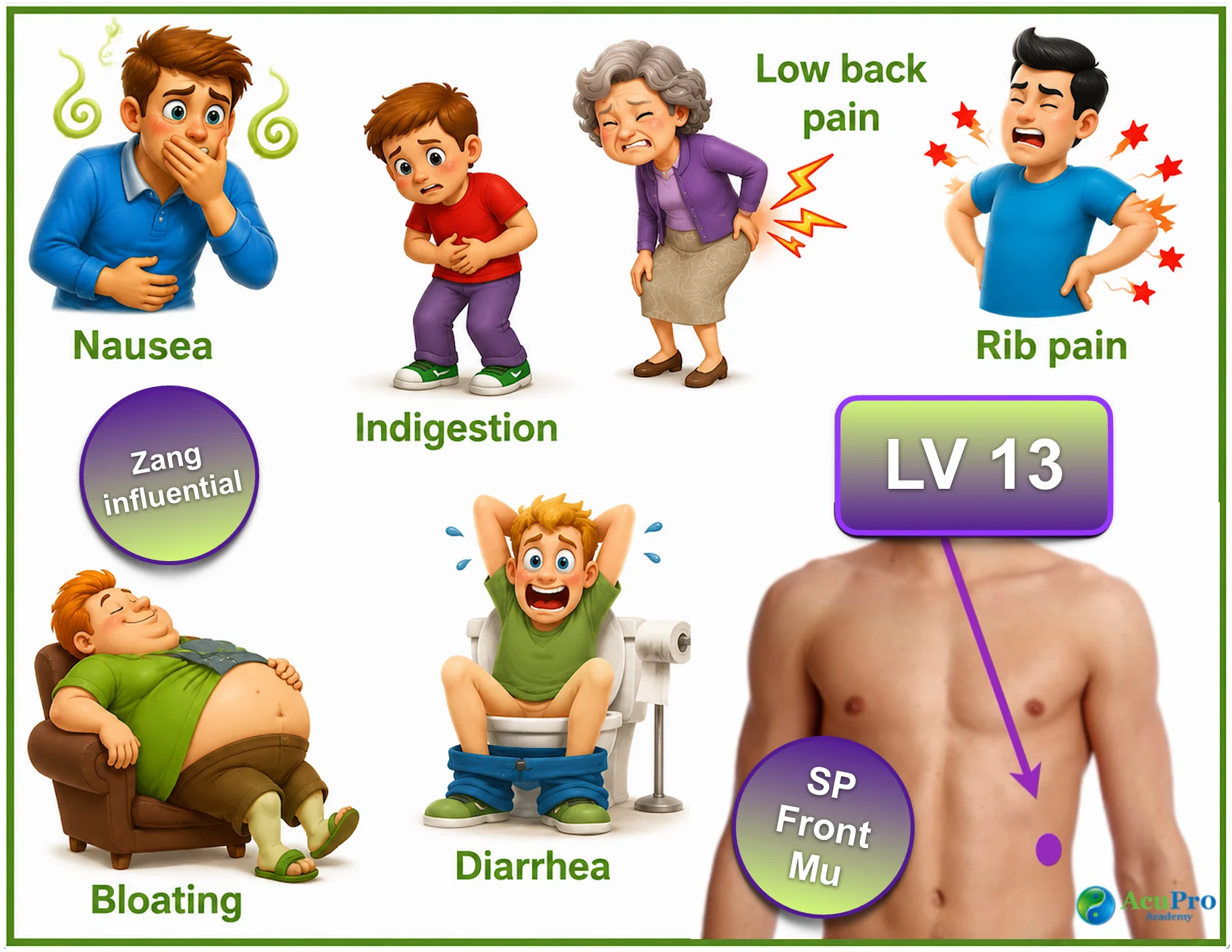
Liver 13 can be considered for issues such as food stagnation, nausea, and abdominal bloating. It can also help address rib-side pain and may be useful when working with patterns involving the Liver and Spleen.
I love points like Liver 13 because they remind us that acupuncture isn’t always about treating a symptom where the patient feels it. The Liver channel can have a profound influence on digestion, movement, and the relationship between different organ systems.
When your patient feels bloated, nauseated, or uncomfortable after eating, Liver 13 is a point worth remembering.
Liver 14: The Final Flourish
Finally, we reach the last point on the Liver channel: Liver 14.
Located four cun lateral to the anterior midline in the sixth intercostal space, Liver 14 is the Front-Mu point of the Liver.
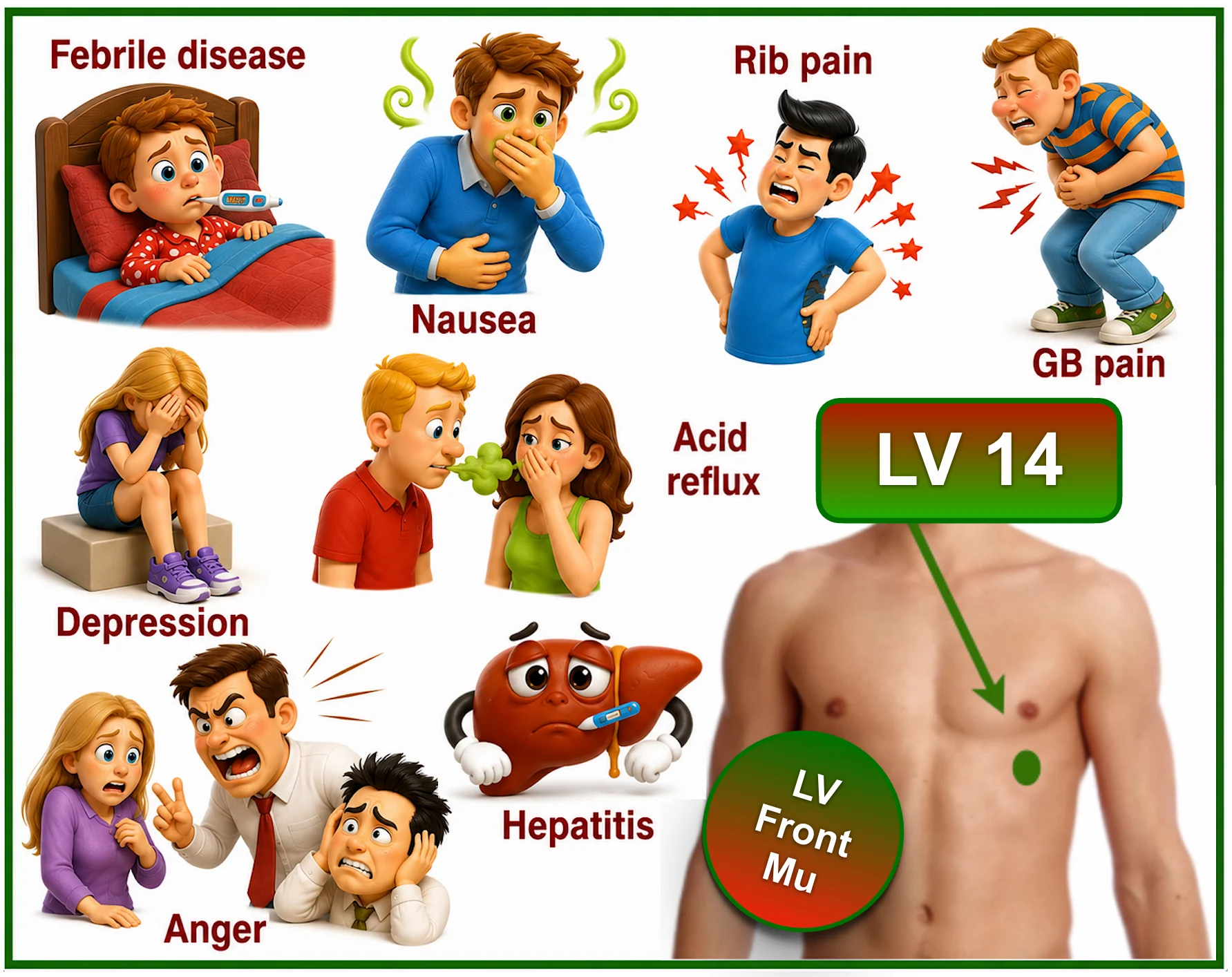
As a Front-Mu point, Liver 14 has a direct relationship with the Liver and is an important point to consider when addressing Liver disharmony.
It’s particularly useful for rib-side pain and discomfort, and it can also be considered when there is a feeling of being emotionally or physically stuck.
This is another point that can be especially interesting for patients who experience stress and tension through the chest and rib area. When Qi isn’t moving smoothly, patients may describe a sense of pressure, tightness, frustration, or feeling like they’re unable to move forward.
Liver 14 can be a beautiful reminder that sometimes we need to help the body (and the emotions) get things moving again.
A Special Acupuncture Combination for Interstitial Cystitis
Now, as promised, let’s talk about a combination that I find particularly interesting for interstitial cystitis.
Interstitial cystitis is a chronic bladder condition characterized by bladder pain and urinary symptoms, without the presence of a typical bacterial infection. It can be incredibly uncomfortable and frustrating for patients, and it’s something I see quite often in clinical practice.
One combination to consider is:
- Liver 5
- Heart 5
- Large Intestine 11
- Large Intestine 4
This combination is used by practitioners as part of a broader treatment strategy to address both the physical discomfort. Some of the emotional challenges that may accompany chronic conditions, including anxiety, stress, and insomnia.
As always, treatment should be individualized according to the patient’s specific TCM pattern and overall presentation. Interstitial cystitis is also a condition that requires appropriate medical diagnosis and management. Acupuncture can be considered as part of a comprehensive approach rather than a replacement for medical care.
Diet and lifestyle can also play an important role in managing symptoms. Identifying individual dietary triggers and making appropriate changes can be an important part of supporting patients alongside their acupuncture treatment.
Bringing It All Together
The Liver channel has so much to offer us clinically. While every point has its own unique actions and indications, these five are some of the points I find myself coming back to again and again.
Liver 2 helps us calm the heat and settle Liver Yang Rising.
Acupoint Liver 3 gets Qi moving and is one of our most valuable points for Liver Qi stagnation.
Liver 5 is an often-overlooked point for Damp-Heat and genital or urinary presentations.
AcuPoint Liver 13 connects us to the broader function of the Zang organs and is especially interesting for digestive concerns.
Liver 14, as the Liver Front-Mu point, gives us another powerful way to work with Liver disharmony, rib-side discomfort, and feelings of stagnation.
The more we understand the channels and the unique functions of individual points, the more confident we become in our point selection.
Thanks for joining me, and as always, keep rocking it using TCM!
Share this article

Written by : AcuPro Academy (Clara)
Related Posts






Latest articles

October 24, 2026
October 24, 2026

October 24, 2026