#124 – How to Use the 44 Acupuncture Points of the Gallbladder Meridian (Podcast)
Listen on Apple Podcasts Listen on Spotify Listen on Amazon Music
🔗 Links mentioned in this episode:
📙 Get your copy of AcuPoints Made Easy Book or PDF
📽️ The Meridian Layers in Acupuncture Theory
🎧How to use the 27 Acupuncture Points of the Kidney Meridian
📽️ The Five Spirits in Chinese Medicine
📽️ Back Shu and Front Mu Acupuncture Points – How to Use Them Effectively
🩵 Curious if Jane is right for your practice? Book a free demo and get a one-month grace period with code ACUPRO1MO!
☯️ More AcuPro Episodes you’ll love:
How to Use the 11 Acupoints of the Lung Meridian
How to Use the 27 Acupoints of the Kidney Meridian
The LUO Connecting Points in Acupuncture
Understanding the Gallbladder’s Role in TCM
Today, we’re diving into one of the most dynamic and clinically useful channels in TCM: the Gallbladder meridian.
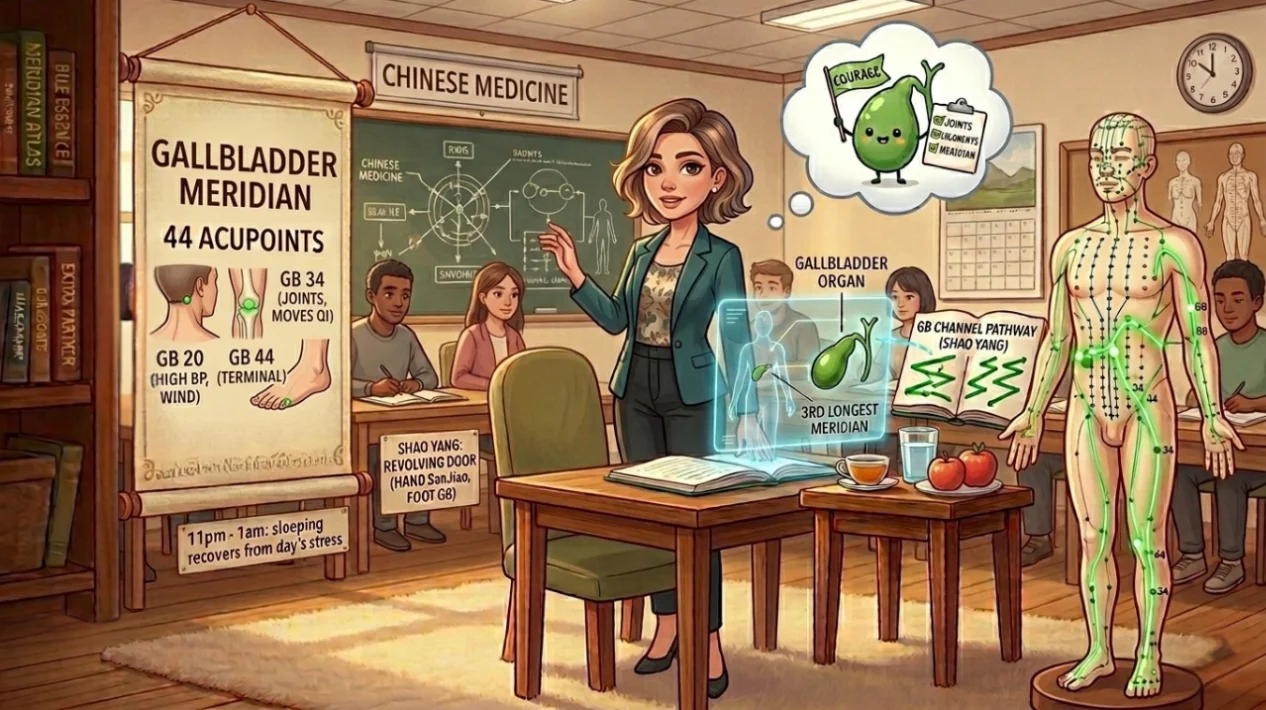
With 44 acupuncture points, this channel is essential for treating pain, tension, headaches, emotional imbalance, and musculoskeletal disorders. Whether you’re a student or a practitioner, mastering this channel can dramatically elevate your clinical results.
The Gallbladder is a yang organ paired with the yin Liver, forming a powerful internal-external relationship.
Core Functions:
- Supports the smooth flow of Qi (via Liver partnership)
- Governs decision-making and courage
- Influences tendons, ligaments, and joints
- Assists in digestive processes (bile secretion)
👉 Clinically, when patients feel:
- Indecisive
- Timid or lacking confidence
- Stuck in life decisions
…it often reflects a Gallbladder imbalance.
What If the Gallbladder Is Removed?
This is a common and important clinical question.
Even if the physical organ is removed:
- The Gallbladder channel still exists energetically
- The functional system remains active, though often weaker
Clinical Insight:
You may need to:
- Strengthen the channel more consistently
- Support digestion and bile function indirectly
- Address emotional patterns like hesitation or doubt
Gallbladder Channel Pathway (GB1–GB44)
The Gallbladder meridian has one of the most complex and zigzagging pathways in TCM.
Pathway Overview:
- Begins at the outer canthus of the eye (GB1)
- Travels through:
- Side of the head
- Around the ear
- Neck and shoulders
- Rib cage and lateral body
- Hip and outer leg
- Ends at the 4th toe (GB44)
Why This Matters Clinically:
This pathway explains why the Gallbladder channel is so effective for:
- Migraines (especially temporal headaches)
- Neck and shoulder tension
- Sciatica and hip pain
- IT band syndrome
Top Gallbladder Acupuncture Points You Must Know
Let’s break down some of the most clinically powerful points:
GB1
- Location: Outer corner of the eye
- Use:
- Bell’s palsy
- Eye disorders
- Facial paralysis
GB20
- One of the most used points in practice
Functions:
- Clears wind
- Benefits the head and senses
- Subdues Liver Yang
Clinical Use:
- Migraines
- High blood pressure
- Neck stiffness
- Stress-related tension
GB21 ⚠️
- Location: Top of shoulder
Functions:
- Relieves neck and shoulder tension
- Moves Qi and blood
⚠️ Important Safety Note:
- Contraindicated in pregnancy (can induce labour)
- Use extreme caution with needling depth
GB34 (He-Sea & Influential Point of Tendons)
This is a must-know powerhouse point.
Functions:
- Benefits tendons and ligaments
- Moves Liver and Gallbladder Qi
- Supports decision-making
Clinical Use:
- Knee pain
- Tendon injuries
- Sciatica
- Emotional stagnation
👉 Think of GB34 anytime you see tightness, stiffness, or indecision
GB41
- Key point for lateral body pain
Use:
- Breast issues
- Temporal headaches
- Hip pain
Gallbladder Channel & Musculoskeletal Health
One of the most important clinical roles of the Gallbladder channel is its influence on:
- Tendons
- Ligaments
- Joint mobility
This makes it essential in treating:
- Sports injuries
- Repetitive strain injuries
- Postural imbalances
👉 Pairing GB34 + Ashi points is often highly effective.
Emotional & Mental Aspect: The Gallbladder Spirit
In TCM, the Gallbladder governs:
- Courage
- Judgment
- Decision-making
Signs of Gallbladder Imbalance:
- Indecisiveness
- Easily discouraged
- Lack of initiative
- Timidity
Clinical Tip:
If your patient says:
“I just can’t decide…”
Think Gallbladder deficiency or stagnation.
Practical Treatment Tips
Here’s how to elevate your treatments:
1. Palpation is Key
Always palpate along the channel:
- Tender points = active points
- Reactivity guides your treatment
2. Combine Local + Distal Points
Example:
- Shoulder pain → GB21 (local) + GB34 (distal)
3. Treat the Channel Pathway
Follow the meridian line of pain, not just the symptom.
4. Consider Lifestyle Factors
- Stress → Liver/Gallbladder stagnation
- Poor posture → channel blockage
- Overtraining → tendon strain
Safety Considerations ⚠️
- GB21: Avoid during pregnancy
- Be cautious with:
- Deep needling near lungs (upper traps area)
- Always assess patient constitution before strong stimulation
Final Thoughts
The Gallbladder channel is one of the most versatile and clinically powerful meridians in Chinese medicine.
By understanding:
- Its pathway
- Its connection to the Liver
- Its role in movement and decision-making
…you unlock a deeper level of treatment precision.
Whether you’re treating pain, emotional stagnation, or mobility issues, this channel will quickly become one of your go-to tools.
Disclaimer
The AcuPro Show podcast and material shared through AcuPro Academy is a subdivision of Natural Health Sense Incorporated. Designed solely for educational and entertainment purposes. The utilization of information from this podcast or any associated material is at the user’s discretion and risk. This content is not meant to replace the guidance of an acupuncturist. Nor Chinese medicine doctor, medical doctor, physician, or any qualified professional. It is not a substitute for proper diagnosis or treatment. Users are strongly advised not to ignore or postpone seeking medical advice for any existing medical condition with their healthcare professional. Regarding any health concerns.
Need the podcast transcript? Click here!
Share this article