Back Shu and Front Mu Acupuncture Points – How to Use Them Effectively
Some things in life just belong together—like baguette and cheese, or peanut butter and jam, so do the Back Shu and Front Mu acupuncture points. In Chinese Medicine, this is a dynamic duo you’ll want to master.
In today’s video, we’ll explore why these points are such a powerful pair, and how you can use them to elevate your clinical practice.
By the end, I’ll share one of my favourite combination hacks that will make your point prescriptions more effective—and once you learn it, you’ll never forget it.
Clara
TCM Geek
Links mentioned in this video:
🛒 AcuPro Store for Courses & Books
💌 Sign up to my FREE newsletter here
Back Shu and Front Mu Acupuncture Points – How to Use Them Effectively
What Are Front Mu & Back Shu Points?
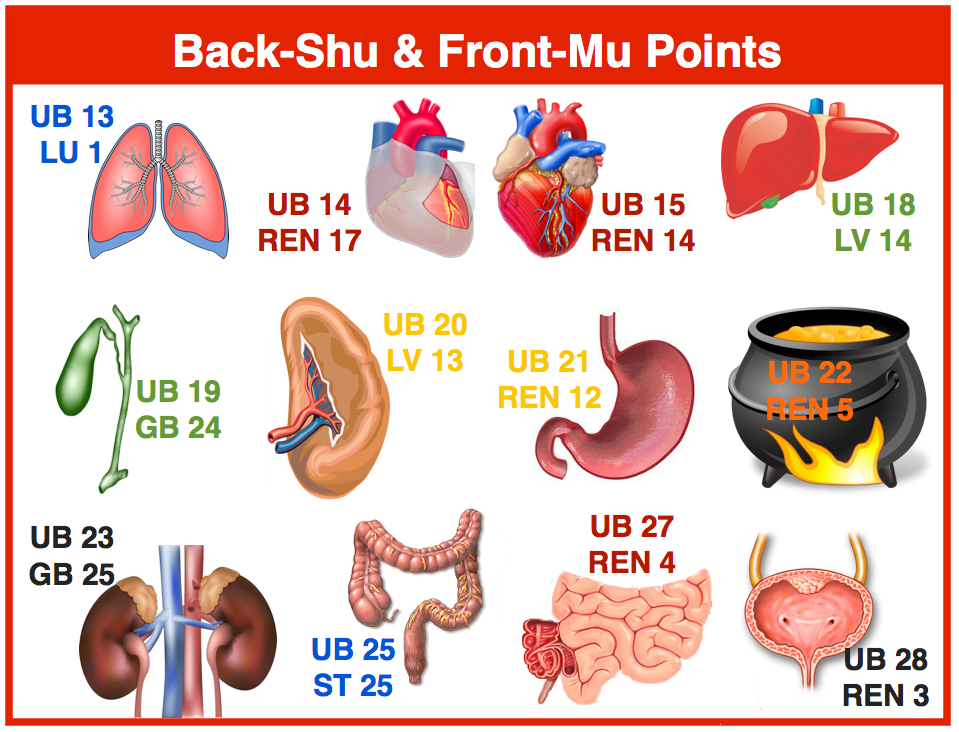
According to TCM, the 12 main meridians each connect to a corresponding organ, and every organ has both a Front Mu and a Back Shu point. These special points are directly linked to organ qi and function.
-
Back Shu Points
-
Located along the Bladder meridian, 1.5 cun lateral to the spine.
-
Transport qi directly to the organ.
-
Best for chronic conditions, deficiencies, and deeper imbalances.
-
-
Front Mu Points
-
Found on the chest or abdomen near their related organ.
-
Gather qi of the organ.
-
Best for acute conditions, often involving yang or excess patterns.
-
👉 Think of Shu points as nourishing the root (long-term support), while Mu points help clear or regulate acute flare-ups.
Yin-Yang of Clinical Use
Choosing between Mu and Shu points often follows the yin-yang principle:
-
Back Shu = Chronic / Deficiency / Internal
-
Front Mu = Acute / Excess / External invasion
A simple but powerful diagnostic tool is palpation. Tenderness at a Mu or Shu point can indicate organ imbalance.
✨ Example: Gallbladder 25 (Front Mu of Kidney) is often tender when kidney function is weak.
Clinical Cases
Let’s look at two examples:
-
Sudden Diarrhea (acute)
-
Use Stomach 25 (Front Mu of LI) + Bladder 25 (Back Shu of LI).
-
Add SP 9 to drain dampness.
-
-
Chronic Bloating & Poor Appetite (deficiency)
-
Use Bladder 20 (Back Shu of SP) + Ren 12 (Front Mu of ST).
-
This harmonizes the middle jiao for long-term digestive support.
-
Favourite Point Pairings
Some powerful combos that I often use:
-
Liver & Gallbladder: GB 24 + BL 18
-
Spleen & Stomach: BL 20 + Ren 12
-
Lung & Large Intestine: LU 1 + BL 13 for respiratory and immune issues
These combinations treat both the root and the branch, front and back, yin and yang.
The Secret Hack
Here’s my go-to method for stacking Front Mu & Back Shu points:
For Liver Qi Stagnation with Blood Deficiency:
-
If I’m treating from the back:
-
Use BL 17, BL 18, and BL 20 to tonify blood and move liver qi.
-
-
If I’m treating from the front:
-
Use LV 14 (Front Mu of LV) + LV 13 (Front Mu of SP) to soothe the liver and support spleen qi.
-
This flexibility allows you to tailor treatments depending on whether your patient is better suited for a back-lying or front-lying session, while still addressing the same root imbalance.
Final Thoughts
Front Mu and Back Shu points are like two sides of the same coin. They don’t just pair well together—they complete each other. When used with intention, they give you diagnostic clarity and powerful treatment options.
So next time you’re creating a point prescription, ask yourself: Does my patient need the support of the Shu, the regulation of the Mu, or both?
And remember—acupuncture rocks because you’re not just treating symptoms, you’re restoring balance. One patient at a time.
Share this article