
TCM Diagnosis Made Easy – Observation Method
When I was in TCM college, my diagnosis teacher used to say: “Practice, practice, practice as much as you can and everywhere!”
I took his words to heart and started practicing my observation skills EVERYWHERE! I looked at people in the bus, and thought to myself: “Oh, that woman with the red cheeks has Yin deficiency. That man with his puffy face has dampness!” I observed people at the gym, the grocery stores, the bank, the beach, on a hike, a run or just sitting at a coffeeshop!
I know what you’re thinking: did people notice me ogling them? Yep! Sometimes, and it was a little uncomfortable but I would just smile, and once I think a guy thought I was flirting with him! Hahahaha!
I also often asked friends to show me their tongue, but it seems people are very private about what’s inside their mouth, because even close friends refused! Everyone agreed to have their pulse taken, but tongue observation proved to be much more difficult to practice. Who knew?
So to continue in the series of posts dedicated to make TCM Diagnosis a little easier to grasp, I just created this one on the “Observation” method in Chinese medicine. Hope you enjoy and benefit from it. Let me know what you think 🙂
And keep rocking it using TCM!
Clara
TCM Geek
PS: And if you feel like reviewing your TCM Foundation, or your TCM diagnosis, click here!
Observation in Chinese Medicine Diagnosis (Nails, Face, Skin, Tongue, Nose)
Observation in TCM
Body
Constitutional Type:
- Wood type (LV): tall & slender
- Fire type (HT): small pointed shin, wider forehead, small hands & feet
- Earth Type (SP): a slightly heavier lower body, large thighs and hips.
- Metal type (LU): broad & square shoulders, strong built & square face
- Water type (KD): a round face & body, long spine, baby face.
Body areas
- A very large barrel-like chest: excess ST condition or dampness
- Very large upper thighs: Sp def.
- Thin, emaciated body: def. of Yin or Blood
- An overweight body: retention of dampness or phlegm and tendency for SP Yang def.
Persona & Aura
- Excess movement, rapid or jerky: excess heat
- Slow or lack of movement: def. cold
Skin colours
- Blue: blocked channels, blood stasis
- Red: heat (excess or def.)
- Yellow: Dampness, water retention, Sp def.
- White: Qi or Yang def. or blood def., internal cold.
- Black: KD def., internal cold, pain, water retention, blood stasis
Hair
- The state of the hair is related to the condition of blood & KD essence
- Premature greying or loss of hair: Kd essence declining
- Falling hair: blood def. or heat in blood (due to stress)
Eyes
The eyes reflect the essence of the organs & the mind (Shen). Dull-clouded eyes: mind & Essence are disturbed or weak.
- Areas of the TCM eyes: Upper lid (Sp), Lower lid (St), Pupil (Kd), Iris (Lv), Inner canthus (Ht), Sclera (Lu)
- Red color in eye inner corner: HT fire
- Red sclera: LU heat
- Yellow sclera: damp-heat
- Whole eye infected: red, painful, swollen: LV fire or wind-heat invasion
- Pale dull sclera: blood def.
- Swelling or black circle under eye: KD def.
Nose
- Blue: abdominal pain. Yellow: Damp-heat. Pale: blood def.. Red: LU heat. Grey: water retention
- Dry nose: ST or LI heat
- Nasal discharge: clear watery (cold pattern), yellow thick (heat pattern)
Ears
- Ears reflect the strength of the KD. A long-full lobe: strong KD, a thin-small lobe: weak constitution
- Blue colour: Pain
- Dry, withered, greyish: Extreme Kd exhaustion
Mouth & Lips:
You can read my post on the observation of the lips here
Tongue Observation
Tongue observation is based on 4 items:
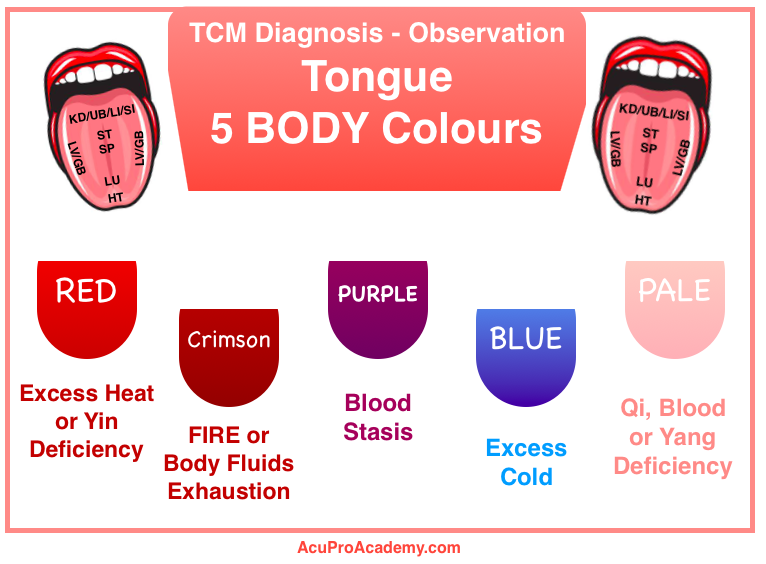
- The body colour: indicates the condition of blood, Qi & Yin organs
- The body shape: indicates the state of blood & Nutritive Qi
- The coating: indicates the state of the yang organs and pathogens
- The moisture: indicates the state of the body fluids
The Tongue body colour: normal is pink
The tongue Shape
- Thin: Def. (blood or Yin)
- Swollen (Fat): dampness (red body: damp-heat; pale body: Yang def.)
- Stiff: interior Wind (precursor of stoke!), extreme heat in HT, Phlegm retention
- Flaccid: Body fluids def., LV & KD Yin extreme exhaustion (if coat is dry & body deep-red)
- Long: HT heat
- Short: interior cold stagnation, or if body red & no coat: extreme Yin def.
- Cracked: Horizontal (ST Yin def.), Midline long crack reaching the tip (HT Yin def.), shallow crack not reaching the tip (ST Yin def.)
- Deviated: interior Wind
- Tremor-like (shaking): interior Wind
- Quivering: SP Qi def.
- Teeth-marks: SP Qi def., Yang def. (if pale body & wet coat)
- Prickled (strawberry like): Excess Toxic heat
The tongue coating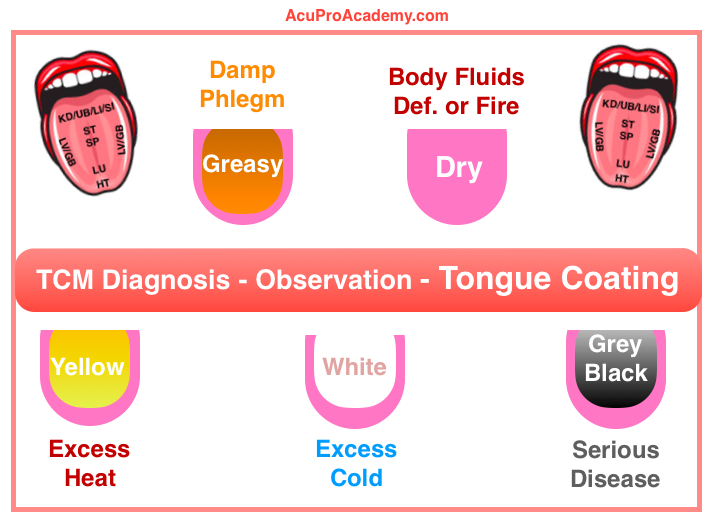
Share this article





Thank you very much. It was very helpful to me
Perfect!
Thank you very much. It is too informative and easy to understand.
My pleasure 🙂
Excellent sharing ! Thanks a lot
My pleasure 🙂
excellent! loved it!
I loved this presentation thank you Clara, you make things seem so siimple and clear – I found the tongue part especially helpful.
Awesome Cate! Happy to help 🙂
Amazing
Hi dear, the Acupuncture course was great. L read all reading materials related to Acupuncture medicine. I would like to obtain my certification in this course.
Thank you. Sincerely,
BASIR A. AZIZI
I’m happy you enjoyed my free courses, I don’t offer certification in acupuncture, just continuing education courses (CEUs, PDAs) credit hours 🙂
Thank you for the easy to understand posts.
thank you so much..kudos to your wonderful work
My pleasure ?
Ik heb video’s van u bekeken en vind het erg leerzaam en helpt mij als beginnend TCM therapeut diagnose te stellen en punten te gebruiken met positive resultaten. Hartelijk dank
Ik ben u toevallig op YouTube tegen gekomen. Heb uw video’s bekeken en deze zijn erg behulpzaam geweest bij het stellen van diagnose als beginnend Tuina therapeut . Hartelijk dank
Very nice presentation for easy understanding. Thank you Clara ❤️
My pleasure 🙂
Génial bravo
Merci beaucoup Clara💜💜💜👍👍👍🤝
Tout le plaisir est pour moi Thaya. J’ai maintenant un chaine YouTube en Français et in page Facebook AcuPro En Français!
Youtube
Facebook
excellent lesson Madam
🩷