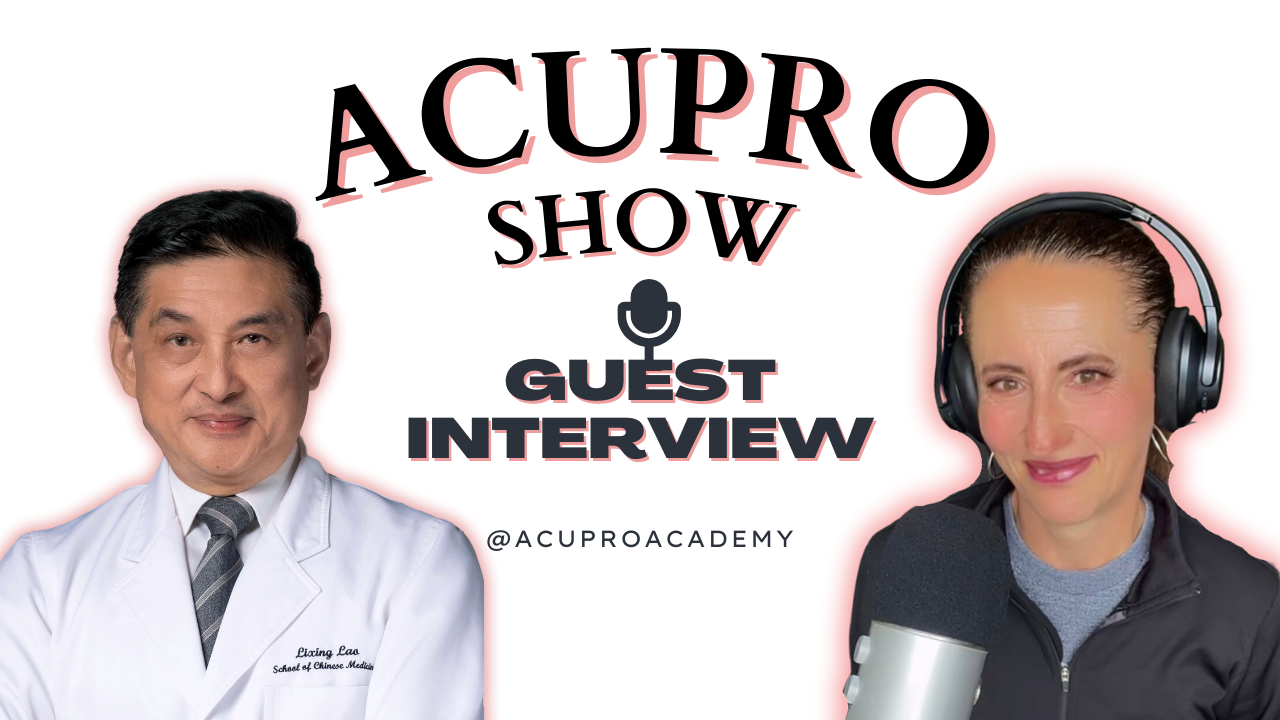
#84 – Being a Modern Acupuncturist in a Modern World: Key Points on How to Thrive Long-Term with Dr. Lixing Lao (Podcast)
Listen on Apple Podcasts Listen on Spotify Listen on YouTube Listen on Amazon Music
 Links mentioned in this episode:
 Scalp Acupuncture Online Course
Dr. Lixing Lao’s Clinic | Instagram
Virginia University of Integrated Medicine Website | Instagram
Show Notes
In this powerful episode of the AcuPro Show, I had the honour of interviewing Dr. Lixing Lao—one of the most influential figures in modern integrative medicine. With over 40 years of experience, Dr. Lao is a true model of what it means to be a modern acupuncturist: blending ancient Chinese wisdom with cutting-edge biomedical science.
From FDA recognition of acupuncture needles to building trust through clinical communication, Dr. Lao reveals key strategies that every acupuncturist can apply right away.
A Journey of Integration: From Shanghai to the U.S.
Dr. Lao trained in Traditional Chinese Medicine (TCM) and Tuina massage at the Shanghai University of TCM. After relocating to the United States, he earned a PhD in Physiology from the University of Maryland. This dual education is what makes him the epitome of a modern acupuncturist—able to communicate fluently in both Eastern and Western medical paradigms.
“Modern acupuncturists must inherit classical knowledge while advancing it with modern science,” — Dr. Lixing Lao
How Dr. Lao Helped Acupuncture Gain FDA Approval
In 1996, thanks in part to Dr. Lao’s research and testimony, the FDA officially reclassified acupuncture needles as medical devices. This milestone:
-
Legitimized acupuncture in the eyes of U.S. healthcare institutions
-
Allowed hospital use and insurance coverage
-
Marked a major victory for every modern acupuncturist practicing today
Dr. Lao’s presentation to the FDA focused on two key areas:
-
Safety of acupuncture
-
Material composition and use of needles
Integrative Education: Training the Modern Acupuncturist
As President of the Virginia University of Integrative Medicine, Dr. Lao has created a progressive curriculum that prepares students to practice confidently in a Western clinical environment.
Here’s how the program supports future modern acupuncturists:
-
First-year curriculum: 70% TCM, 30% Western medicine
-
Advanced clinical courses: Combine Western diagnostics with TCM differential diagnosis
-
Research-based approach: Encourages students to use credible sources like the Cleveland Clinic and Mayo Clinic
Students graduate equipped to treat, explain, and communicate like seasoned professionals—vital traits for any modern acupuncturist.
Understanding How Acupuncture Works (Without Saying “Qi”)
One of the biggest challenges for new practitioners is explaining acupuncture in modern language.
Dr. Lao breaks down the scientific mechanism of acupuncture:
-
Peripheral Response – Needling triggers endorphins and local tissue repair
-
Spinal Cord Reaction – Blocks pain through the gate control mechanism
-
Brain Activation – Stimulates the hypothalamic-pituitary-adrenal axis for systemic regulation
These insights help every modern acupuncturist bridge the gap between traditional language and scientific explanation.
Communicating with Patients Like a Pro
When patients ask, “How does acupuncture work?”—don’t default to abstract concepts. Use modern language:
-
 “You have Liver Qi stagnation.”
 -
 “Your stress is causing stomach acid to rise, which leads to heartburn. Let’s help your body regulate this naturally.”
This kind of explanation builds trust, shows professionalism, and solidifies your role as a modern acupuncturist in today’s health landscape.
Tuina Massage: A Powerful Tool for the Modern Acupuncturist
Tuina (Chinese medical massage) is underutilized in the West but has enormous potential, especially for:
-
Pediatric care
-
Chronic and acute pain
-
Frozen shoulder (especially in menopausal women)
While Tuina requires time and practice to master, it provides an excellent hands-on tool for the modern acupuncturist looking to expand their therapeutic toolkit.
Tips for New Practitioners: Confidence, Knowledge, and Communication
Dr. Lao’s top advice for new or struggling practitioners:
-
Master your craft: Know your point locations, indications, and safety protocols inside and out
-
Study modern physiology: Know how diseases are diagnosed and treated in the Western world
-
Practice non-painful needling: “No pain, much gain” is a mantra every modern acupuncturist should live by
-
Keep learning: Continuing education is essential to stay relevant and effective
Embrace the Challenges—and the Opportunities
With increasing insurance coverage, more hospital integration, and the opioid crisis demanding non-pharmaceutical solutions, acupuncture is more in demand than ever. But challenges remain:
-
Some physical therapists and MDs are encroaching on dry needling territory
-
Misconceptions about TCM still exist in mainstream medicine
The solution?
“Arm yourself with modern knowledge. When you can speak both languages—TCM and biomedical—you will thrive as a modern acupuncturist,” — Dr. Lixing Lao
The Future Is Bright for the Modern Acupuncturist
From frozen shoulder to fertility, pain to PTSD, acupuncture is proving itself in every clinical setting imaginable. However, success in this field requires more than just inserting needles—it necessitates adaptability, compassion, and a continuous desire to learn.
If you’re a student or new practitioner: take heart. With mentors like Dr. Lixing Lao leading the way, the future of the modern acupuncturist is incredibly bright.
Disclaimer
The AcuPro Show podcast and material shared through AcuPro Academy are subdivisions of Natural Health Sense Incorporated. Designed solely for educational and entertainment purposes. The utilization of information from this podcast or any associated material is at the user’s discretion and risk. This content is not meant to replace the guidance of an acupuncturist. Nor a Chinese medicine doctor, medical doctor, physician, or any qualified professional. It is not a substitute for proper diagnosis or treatment. Additionally, as well as users are strongly advised not to ignore or postpone seeking medical advice. For any existing medical condition, with their healthcare professional. Regarding any health concerns.
Need the podcast transcript? Click here!
Share this article